
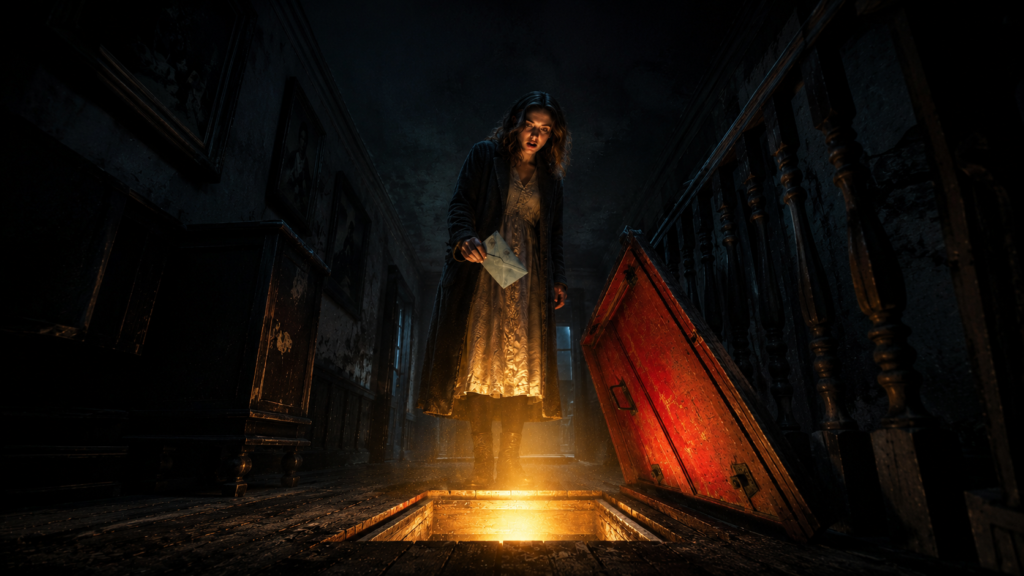
Sara thought she knew everything about her quiet little life.
Then one morning, a letter arrived at her post office. It was fifteen years old. It was addressed to her. And it was written in her own handwriting.
She never wrote it. But whoever did knew a secret that was hidden under her childhood home, behind a small red door.
Some letters should stay lost. This one refused.
Part One: The Letter That Should Not Exist
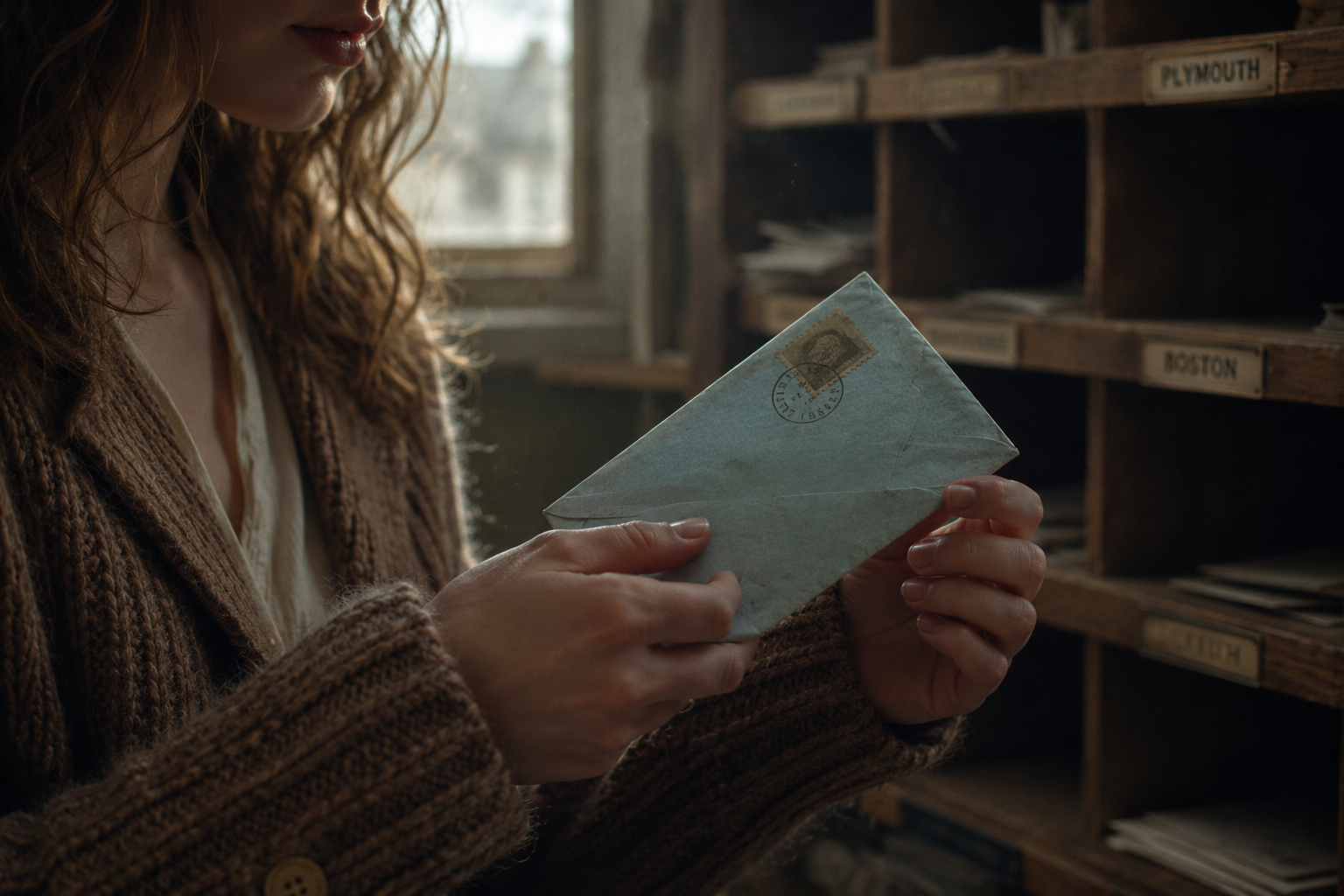
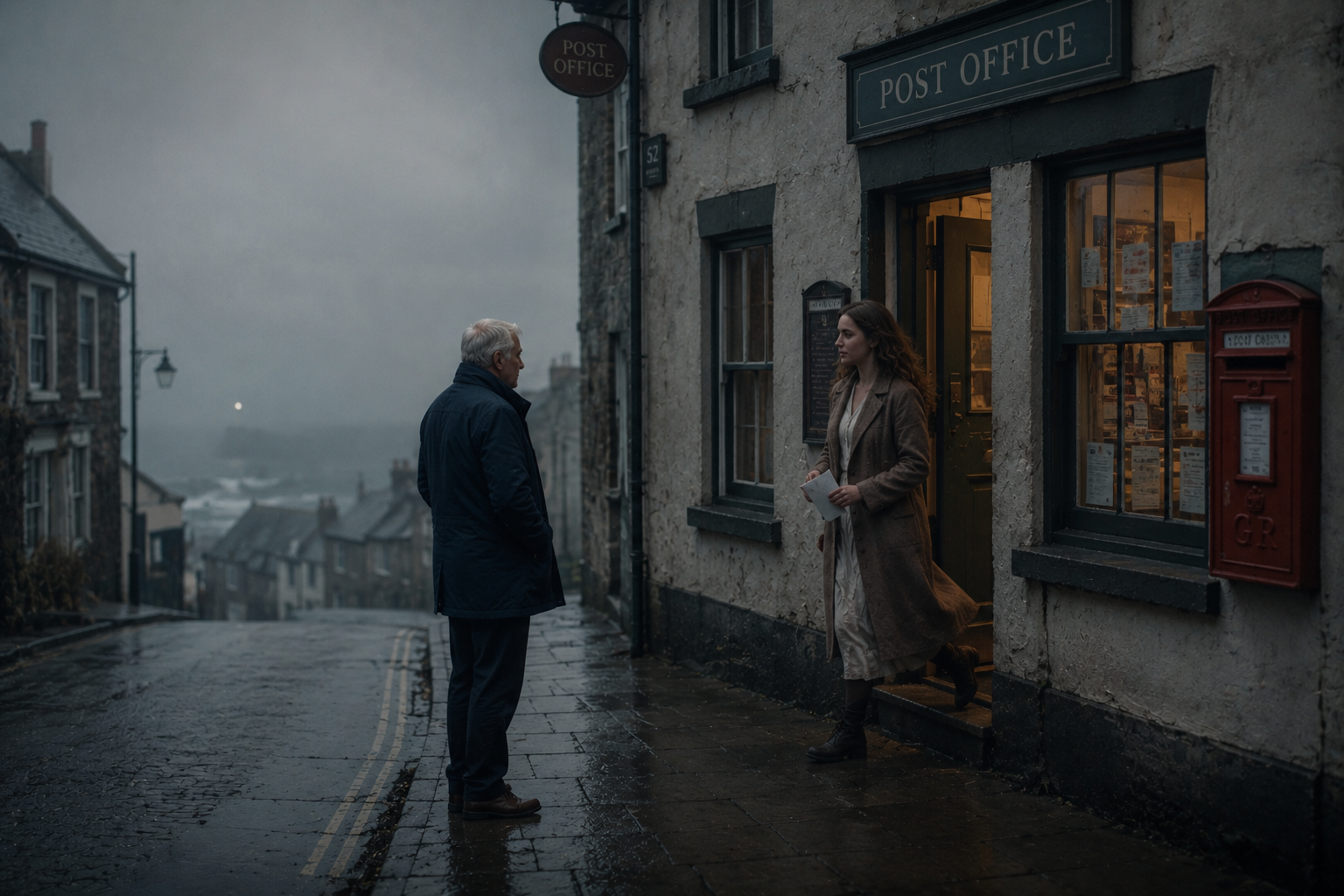
Sara worked at the small post office in Milbrook, a quiet town by the sea. Every morning she opened the office at eight, sorted the letters, drank her coffee, and watched the fishing boats through the window. Nothing exciting ever happened in Milbrook. That was exactly why she liked it. After a difficult childhood, a quiet life felt like a gift.
Then, on a cold Tuesday in October, she found the blue envelope.
It was lying between two ordinary bills, thin and pale blue, like a piece of winter sky. The paper was old and soft, and the stamp looked strange, a design that was not used anymore. Sara picked it up and turned it over. When she read the postmark, her heart jumped. The letter had been posted fifteen years ago.
Old letters sometimes arrive late. Every postal worker knows stories like that. A letter falls behind a machine, or it is forgotten in a box, and one day somebody finds it and sends it on its way. That part was unusual, but not impossible.
The impossible part was the handwriting.
It was her own.
The envelope was addressed to “Sara Bell, Milbrook Post Office” in neat blue ink. Sara knew her own handwriting the way she knew her own face. The round letters, the small circle over the letter i, the way the y curled at the end. It was all there. But she had never written this letter. She was completely sure of it. Fifteen years ago she was only twelve years old, and she lived with her mother in another town, far from the sea. Back then, she had never even heard of Milbrook.
Her hands were shaking when she opened the envelope. Inside there was one small piece of paper with one short sentence:
“Go back to the house. Open the red door.”
Sara read the sentence five times. There was no name, no date, no explanation. Just those nine words, written in ink that had turned slightly brown with age.
Her colleague, old Mr. Hale, noticed her face. He had worked at the post office for forty years and had seen everything.
“Bad news?” he asked kindly.
“I don’t know yet,” Sara said slowly. “Mr. Hale, is it possible for a letter to wait fifteen years and then arrive?”
He thought about it. “Possible? Yes. I once delivered a postcard that was fifty years late. But strange things like that usually have a simple explanation.” He smiled. “Usually.”
All day, Sara could not stop thinking about the letter. She served customers, sold stamps, and smiled politely, but her mind was far away. She felt confused, and under the confusion there was something else, something colder. Fear. She did not understand why, but the words “the red door” touched something deep inside her, like a bell ringing in a dark room.
That evening, in her small flat above the bakery, she called her mother.
“Mum, can I ask you something strange? Did we ever have a red door? In the old house, maybe?”
There was a long silence on the phone. Too long.
“Why are you asking that?” her mother finally said. Her voice sounded different. Careful. It was the voice she used to use when Sara asked about her father.
“No reason. I just remembered something.”
“Sara.” Her mother took a deep breath. “Some things are better left in the past. Trust me.”
Then she started talking about the weather, and Sara let her. But when the call ended, Sara sat in the dark kitchen for a long time. Her mother had not said no. She had not laughed and said, “A red door? What are you talking about?” She had said that some things were better left in the past.
Sara knew, without any doubt, that the red door was real.
Part Two: The Road Home
On Saturday morning, Sara drove three hours to her childhood home.
The road went through hills and small villages, and she had plenty of time to think. She thought about her father, who had died at sea when she was seven. She could hardly remember him now. A big laugh. Strong hands lifting her onto his shoulders. The smell of salt and engine oil on his jacket. That was all that was left.
After his death, her mother had changed. She became quiet and nervous. She never talked about him, and she never let Sara ask questions. When Sara was twelve, they moved away from the old house, quickly, almost like people running from something. Her mother had never sold the house, but she had never visited it either. As a child, Sara used to think this was normal. Now, driving through the grey morning, she asked herself for the first time: why would a woman keep a house for twenty years and never go inside?
If her mother was hiding something, it was hidden in that house.
The thought frightened her, and at the same time it pulled her forward like a rope.
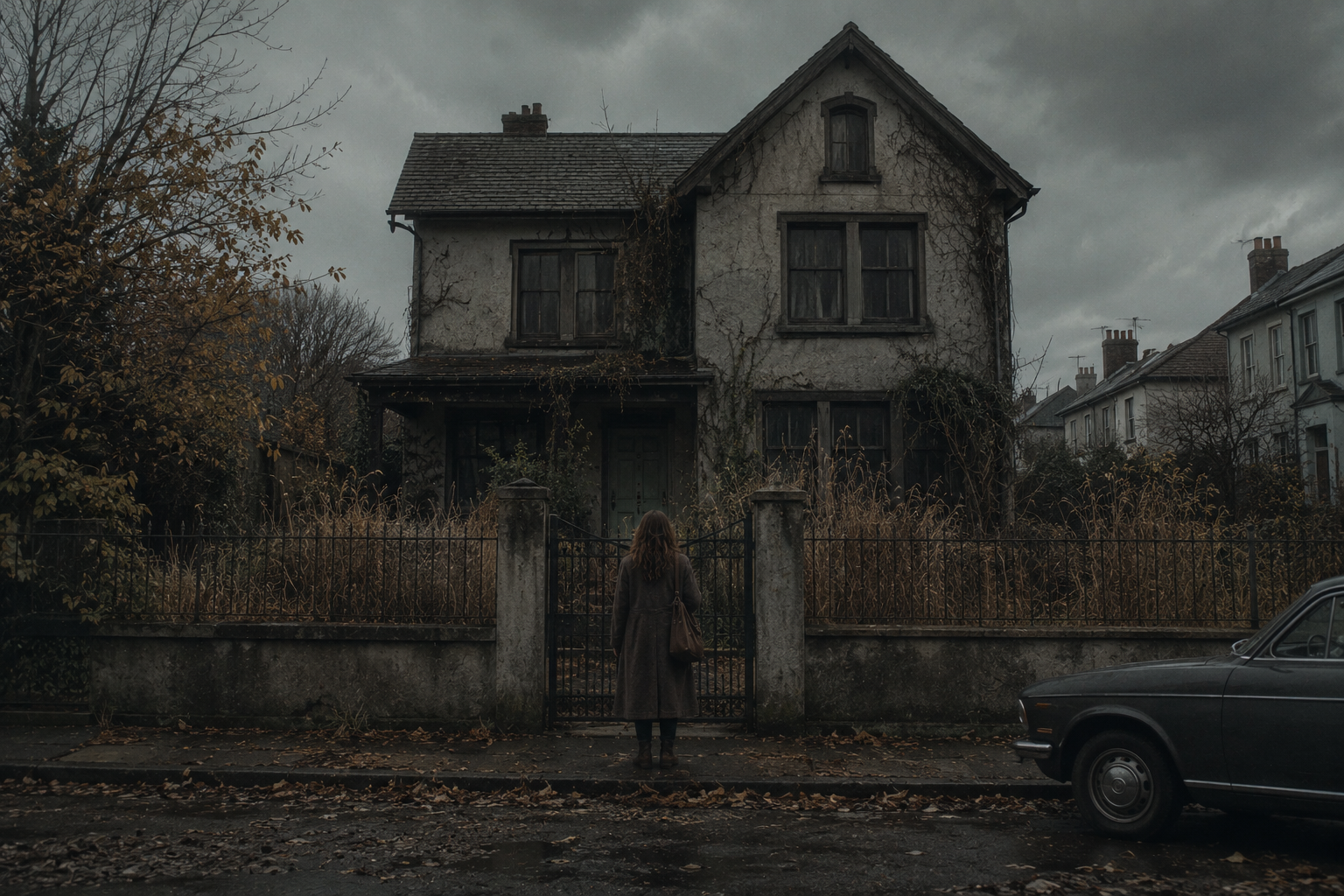
The house stood at the end of a narrow street, grey and tired, with dead plants in the garden and dark windows like closed eyes. Sara parked the car and sat for a moment, looking at it. She felt like a child again, small and uncertain. Part of her wanted to drive straight back to Milbrook and forget the whole thing. It would be easy. She could throw the letter away and continue her quiet life.
But she knew she would never forgive herself if she did that. She had spent her whole life not asking questions. Today, that was going to end.
The key was still under the same stone by the door. Some things never change.
Inside, the air smelled of dust and old wood. Sara walked slowly through the rooms of her childhood. The kitchen where she used to do her homework. The living room where she watched cartoons on Saturday mornings. Everything was smaller than she remembered, and everything was covered with a soft grey skin of dust.
She checked every door in the house, upstairs and downstairs. White, white, brown, white. No red door anywhere. She even looked in the garden shed. Nothing.
She was standing in the hallway, tired and disappointed, when she noticed the carpet.
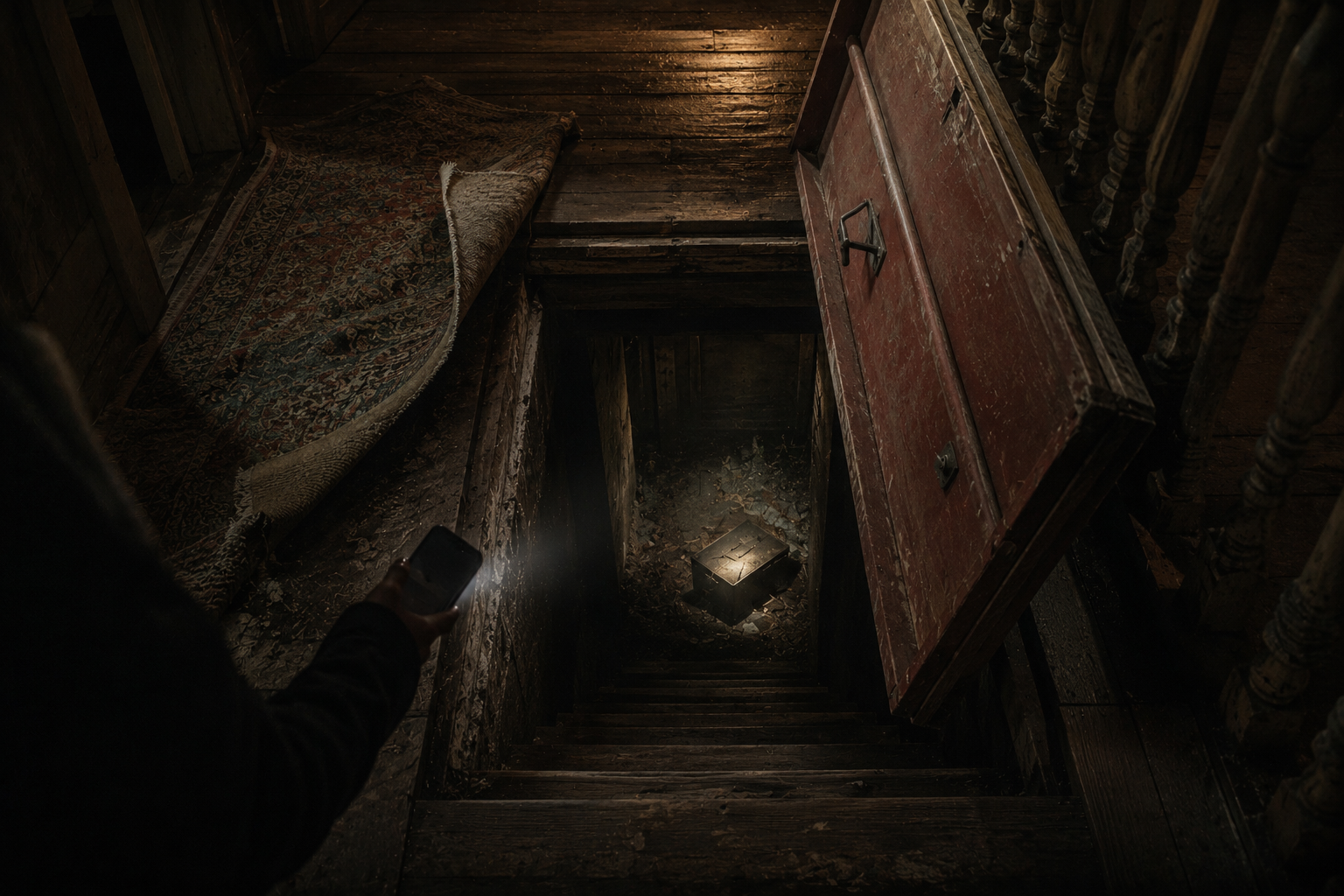
The carpet near the stairs looked different from the others. It was newer, cleaner, and one corner did not lie flat. Sara’s heart began to beat faster. She knelt down, took the corner, and pulled the carpet back.
Under it, there was a wooden door in the floor. A door to a cellar.
The door was painted red.
Part Three: Behind the Red Door
For a moment, Sara could not move. She had found it. The door from the letter was real, and somebody had hidden it under a carpet, in a locked and empty house.
She pulled the red door open. Old stairs went down into the dark, and cold air rose up to meet her, smelling of stone and earth. She turned on her phone light and climbed down carefully, step by step, holding the wall with one hand.
The cellar was small and almost empty. There were no boxes of old toys, no broken furniture, none of the things people usually keep in cellars. There was only one thing in the room: a metal box, sitting in the middle of the floor, waiting. It looked like it had been placed there for her.
Sara knelt on the cold floor and opened it.
Inside the box there were letters. Dozens and dozens of letters, all addressed to her, all with foreign stamps. Australia. Japan. Brazil. Norway. The oldest one had been posted twenty years ago. The newest had been posted last spring.
Every letter began with the same words: “My dear Sara, I hope one day you will read this.”
They were from her father.
Sara sat down on the floor because her legs suddenly felt weak. Her father. Her father, who had died at sea when she was seven. Her father, whose funeral she remembered, whose grave she had visited with flowers every year until they moved away.
With shaking hands, she opened the oldest letter and started to read.
Her father was alive. He had been alive all this time. In the first letter, he explained everything: the terrible argument, the mistake he had made, the night her mother told him to leave and never come back. He wrote that he did not blame her mother. He wrote that he had destroyed his family with his own hands, and that leaving was the price. But he could not disappear completely. So he wrote letters. He worked on ships, and from every port in the world, he sent a letter to his daughter.
And her mother had kept every single one. She had not burned them. She had not thrown them away. She had hidden them here, in the cellar, behind the red door, under the carpet. Sara tried to understand what that meant. If her mother truly hated him, she would have destroyed the letters. But she had saved them, all of them, for twenty years. Maybe, deep inside, her mother had always known that one day Sara would need the truth. Maybe hiding the letters was the only way she could protect her daughter and keep the truth alive at the same time. Love and fear, locked in the same box.
Sara read for hours. She laughed at some letters and cried over others. Her phone battery slowly died, and she moved to the stairs, where a little grey light came down from the hallway. She felt angry and sad and strangely happy, all at the same time. Twenty years of birthdays, of questions, of silence. All of it could have been different.
The last letter, the one from spring, ended differently from the others:
“I am old now, and I am tired of the sea. I have bought a small house in a town called Milbrook. Maybe you have heard of it. I chose it because I learned that you work there. I walk past your post office every Friday morning, but I never have the courage to come in. I am afraid of your face when you see me. Perhaps, if you ever find these letters, you will also find the courage that I lost.”
Sara looked up from the paper. Milbrook. Every Friday morning.
She had six days to decide what she would say to the old man who walked past her window.
Part Four: The Question Without an Answer
That night, Sara drove home in the dark with the metal box on the seat beside her.
She did not call her mother. Not yet. She was too angry to speak calmly, and she did not want to say words that could never be taken back. Her mother had lied to her for twenty years. But her mother had also kept the letters. Both things were true at the same time, and Sara was learning that the truth is rarely simple.
On Friday morning, she stood behind the counter of the post office at eight o’clock, watching the street through the window. Mr. Hale watched her watching.
“You’re waiting for someone,” he said. It was not a question.
“Yes,” Sara said. “I think I’ve been waiting for him for twenty years.”
At ten past nine, an old man in a dark blue coat walked slowly past the window. He had white hair and a careful way of walking, and when he passed the post office, he turned his head and looked at the door for one long second. Then he walked on.
Sara was outside before she even decided to move.
“Dad,” she said.
The old man stopped. He turned around very slowly, and Sara saw her own eyes looking back at her from a stranger’s face.
What happened next belongs to them, and some moments are too private for stories.
But one question still had no answer, and it kept Sara awake for many nights afterwards. Her father had written the letters. Her mother had hidden them. Her father knew nothing about the blue envelope, and her mother swore she had never sent it.
So who wrote a letter in Sara’s own handwriting, fifteen years ago, telling her to open the red door? And why did it arrive on exactly the right Tuesday, in exactly the right October?
Nobody in Milbrook could tell her.
Not yet.
The End
| Word | Simple Meaning | Example |
|---|---|---|
| envelope | the paper cover that holds a letter before you send it | She wrote the address on the envelope and posted it. |
| postmark | the official mark on a letter that shows where and when it was sent | The postmark showed that the card was sent from Paris in 1990. |
| handwriting | the way a person writes with a pen, which is different for every person | The doctor’s handwriting was so bad that nobody could read it. |
| cellar | a room under a house, often used for keeping things | They keep old furniture and boxes in the cellar. |
| carpet | a thick soft material that covers a floor | The cat was sleeping on the warm carpet in front of the fire. |
| courage | the strength inside you that helps you do something difficult or frightening | It took a lot of courage to speak in front of five hundred people. |
| argument | an angry conversation between people who do not agree | They had a big argument about money and did not speak for a week. |
| funeral | the ceremony that happens when a person dies | Hundreds of people came to the old teacher’s funeral. |
| colleague | a person who works with you in the same place | My colleague helped me finish the report before the meeting. |
| blame | to say that someone is responsible for something bad | Don’t blame me for the mistake, I wasn’t even there. |
| port | a town or area by the sea where ships arrive and leave | The ship stayed in the port for three days before sailing to Japan. |
| dust | the fine grey powder that covers things in old or closed rooms | The old piano was covered with a thick layer of dust. |