Some rivers forgive you if you make a mistake. This one does not. I found my brother’s journal three days before I found the truth about what happened to him. This is a longer piece of english story reading, written for learners who are ready for real tension, not just vocabulary practice. If you like stories where every decision matters, and where one wrong turn can cost you everything, keep reading.
Table of Contents
- Part One: The Empty Canoe
- Part Two: Upriver
- Part Three: The Wall of Water
- Part Four: The Eastern Channel
- Part Five: What the River Gave Back
- Key Vocabulary
Part One: The Empty Canoe
My brother Theo had not answered a single radio call in three weeks, and the survey institute had already started talking about him in the past tense. I refused to do the same. If they were not going to send another expedition upriver to find him, then I would find a way to go myself, whatever it cost me.
Theo and I had never agreed on much. He chased unmapped rivers the way other people chased careers or money, and I had spent most of my adult life quietly worrying that one of those rivers would eventually take something from him that he could not get back. I used to tell him that a map only needed to be accurate, not complete, and he used to laugh and tell me I had never once understood why he did this work at all. Standing in the institute’s office, listening to men who had never met him discuss his case file like a closed matter, I finally understood something he had tried to explain to me for years. Some places refuse to stay unknown, no matter how much easier that would be for everyone else.
The research station sat at the edge of the rainforest, where the wide, brown main river narrowed into a maze of smaller channels that most maps still marked as unexplored. I arrived at dawn with a single bag and a stubborn plan, and I was introduced to Iko, the guide who knew this river better than anyone alive. He looked at me for a long moment before he agreed to take me, and I understood, even then, that he was not fully convinced this was a good idea.
“The water is rising early this year,” Iko said, tying supplies into the canoe with quick, practiced hands. “If it rises much more before we reach the upper channels, we will lose our best route within a week.” I nodded as though I understood the danger completely, though I would only understand it fully much later, in ways I did not yet want to imagine. He studied my face for a moment, the way a person studies weather they do not fully trust, and then simply went back to tightening the ropes.
As we prepared to leave, one of the station workers called us over to the far end of the dock. A canoe had drifted in overnight, empty, its paint faded and scratched along one side. Iko crouched beside it, running his fingers over a small, painted symbol near the bow, and his expression changed completely.
It was Theo’s canoe.
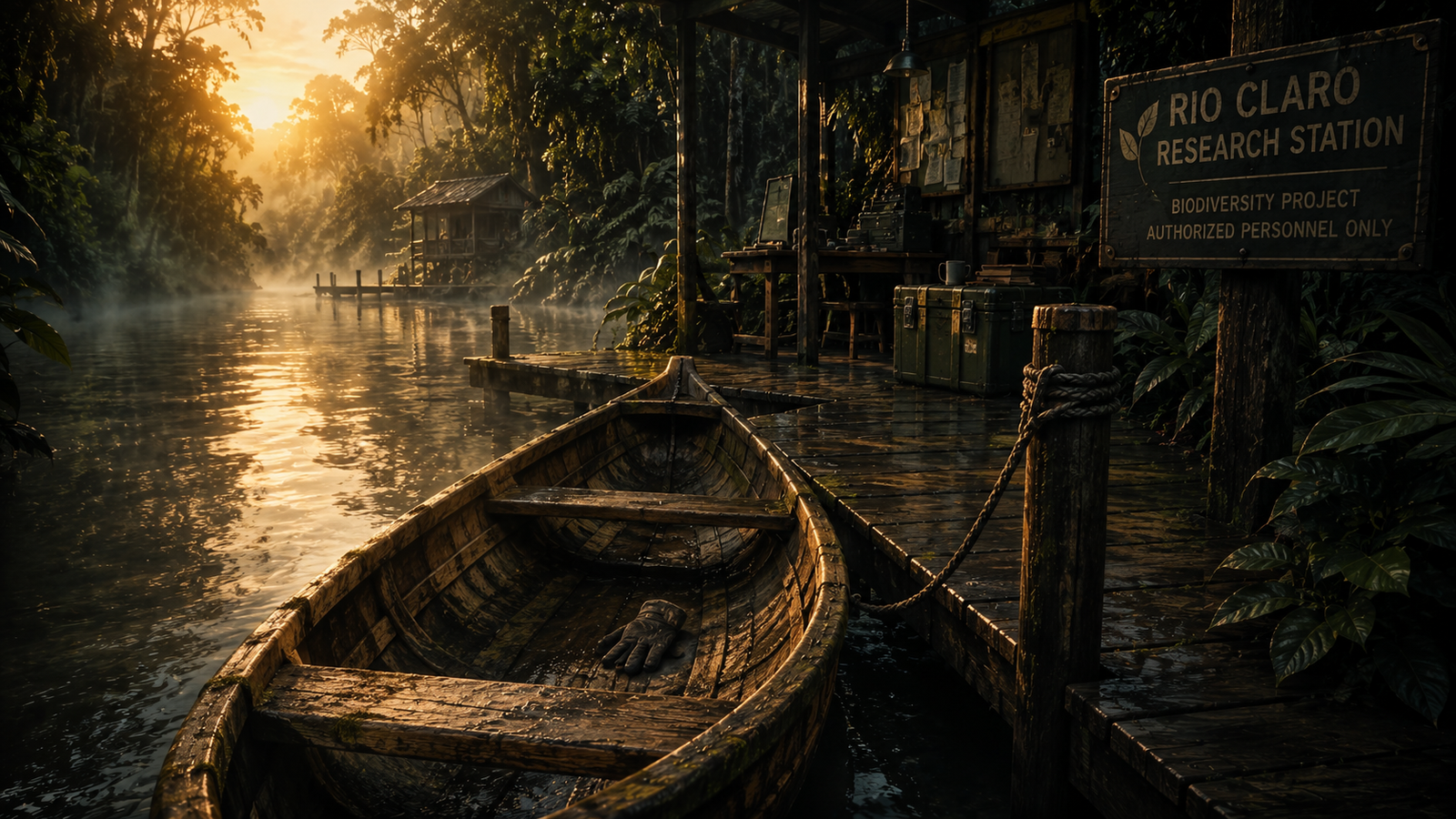
There was no note inside it, no sign of what had happened, only a single, waterlogged glove wedged beneath the seat. If Theo had lost this canoe on purpose, he would have taken the glove with him. If he had lost it by accident, that meant something out there on the river was strong enough to take a boat away from an experienced surveyor without warning. Neither answer made me feel any better about what we were about to do, and for the first time since leaving home, I felt real fear settle somewhere behind my ribs, quiet and heavy, refusing to leave.
Part Two: Upriver
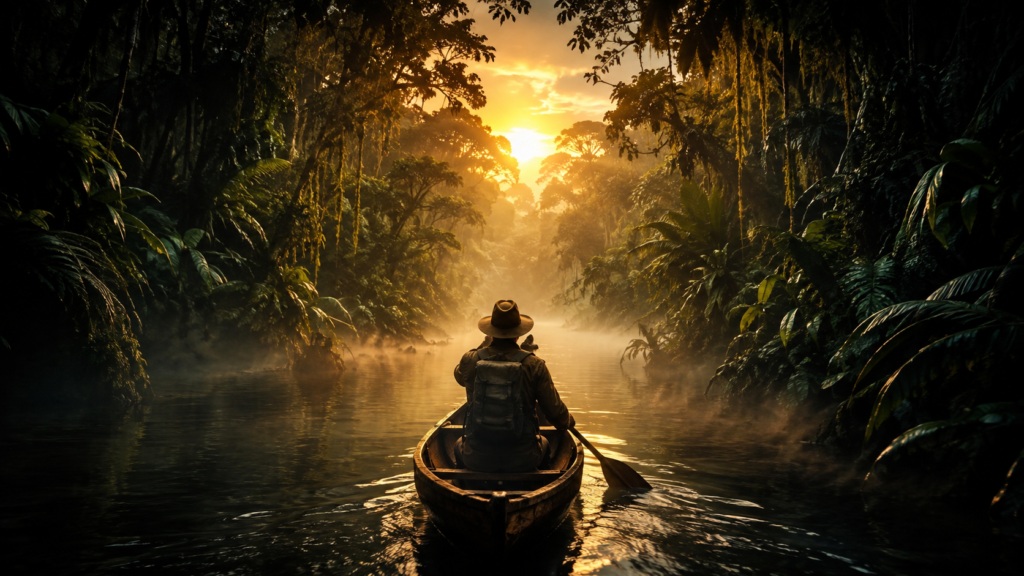
The first two days upriver were slow and quiet, the kind of quiet that makes you notice every sound the forest makes around you. Iko read the water constantly, adjusting our course around submerged rocks and fallen trees that I would never have noticed on my own. If I had come out here alone, I would not have survived the first afternoon, and I said as much to him on the second evening, half joking and half completely serious.
“You would have,” he said simply. “Not comfortably. But you would have.”
We talked more than I expected to on that second night, sitting close to a small fire while the forest made its usual restless noise around us. Iko had worked with Theo twice before, on shorter surveys further downstream, and he spoke about my brother with a kind of careful respect that surprised me. “He always wanted to see what was around the next bend,” Iko said. “Even when the smart choice was to stop.” I told him that was the most accurate description of my brother I had heard from anyone in years, and something in the way he nodded told me he already understood exactly what that trait might have cost him.
On the morning of the third day, we found Theo’s old camp, tucked into a bend in the river where the current briefly slowed. The tent had been cut open rather than unzipped, the fabric torn in a long, ragged line. Papers were scattered across the wet ground, most of them ruined beyond reading, but one notebook page had survived, tucked under a rock as though someone had deliberately weighted it down to keep it from washing away.
The handwriting was unmistakably Theo’s, rushed and slanted, the way he always wrote when he was excited rather than afraid. “Found something the old maps never showed,” it read. “If this is what I think it is, it changes everything we know about this river system.” There was no explanation of what “this” actually was, only a rough sketch of a narrow channel branching east, away from the main route we had been following.
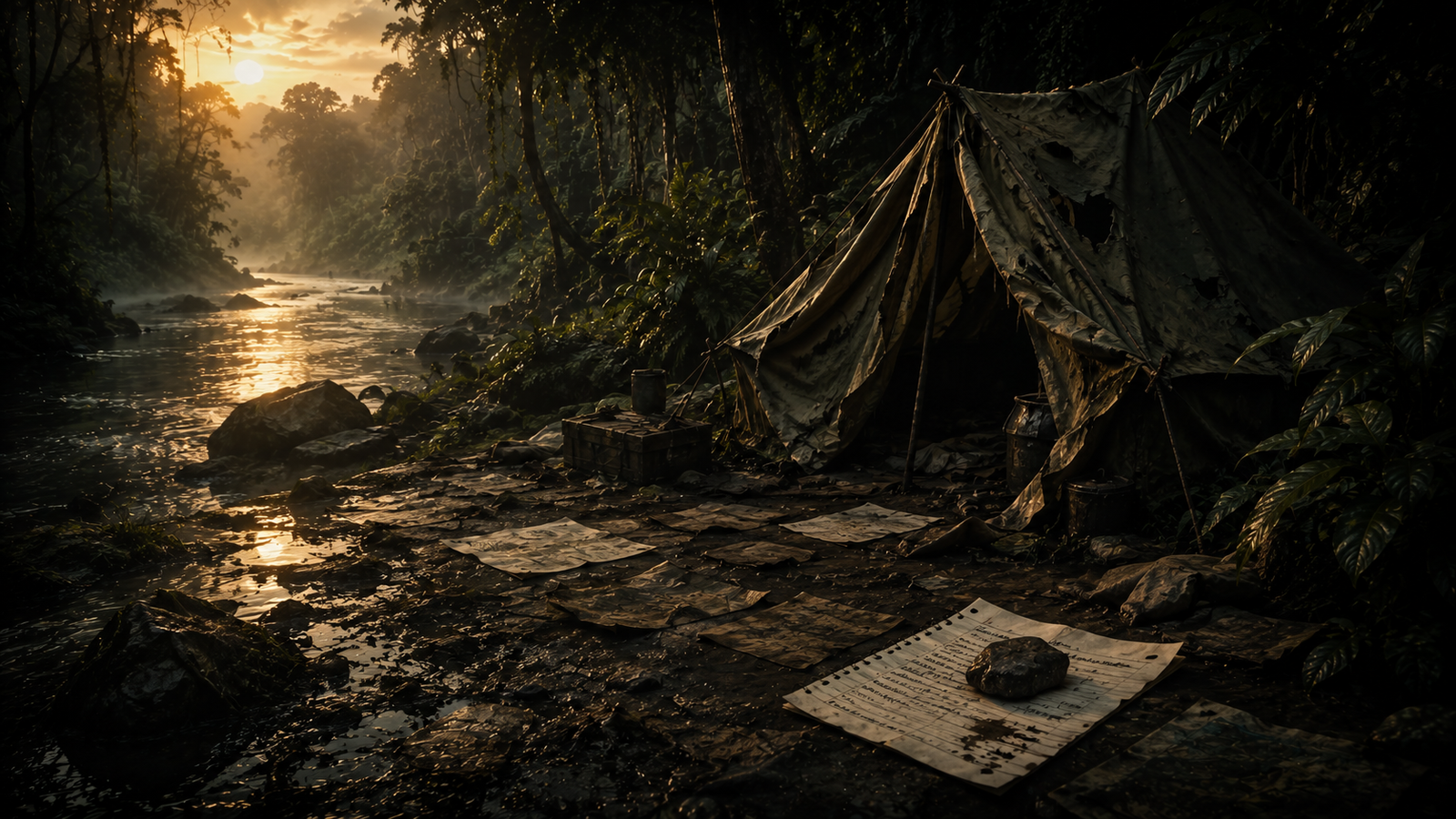
I sat with that page for a long time, turning it over in my hands as though the back of it might explain the front. My brother had always been like this, chasing discoveries the rest of the world had not caught up to yet, and I had spent half my life both admiring that and quietly resenting it. If he had found something extraordinary out here, I both hoped and feared that we were about to find it too. Iko packed the camp’s few salvageable supplies in silence, and I noticed he kept glancing toward the eastern branch on the sketch, his jaw tight in a way I had not seen from him before.
We were still crouched over the ruined camp when a low, distant rumble rolled through the trees, too long and too heavy to be thunder.
Part Three: The Wall of Water
Iko was on his feet before I had even fully registered the sound. “Storm surge,” he said, already gathering our gear. “Upriver, probably from the hills. If that water reaches the gorge before we do, it will hit us like a wall.” I did not need him to explain what “like a wall” meant. I had read enough survey reports to know exactly what a flash flood could do to a narrow river channel in minutes.
We half ran, half stumbled toward higher ground, dragging the canoe with us over slick roots and loose stone. My lungs burned, my hands were shaking, and every few seconds I glanced back toward the bend in the river, half expecting to see the water already rising behind us. If we had left the camp even five minutes later, I do not think we would have made it to the ridge in time. My mind kept circling back to Theo, somewhere further upriver, and whether he had faced this exact sound once already, alone, with no one running beside him.
We reached higher ground just as the sound became a roar. The river below us swelled and darkened within seconds, carrying broken branches and churned mud in a current so fast it barely looked like water anymore. Iko pulled me back another step, his grip firm on my arm, and for a long moment neither of us spoke at all. I remember thinking, with strange clarity, that I had never truly understood the size of what we were dealing with until that exact moment, watching an entire section of forest disappear beneath brown, churning water in less time than it took to catch my breath.
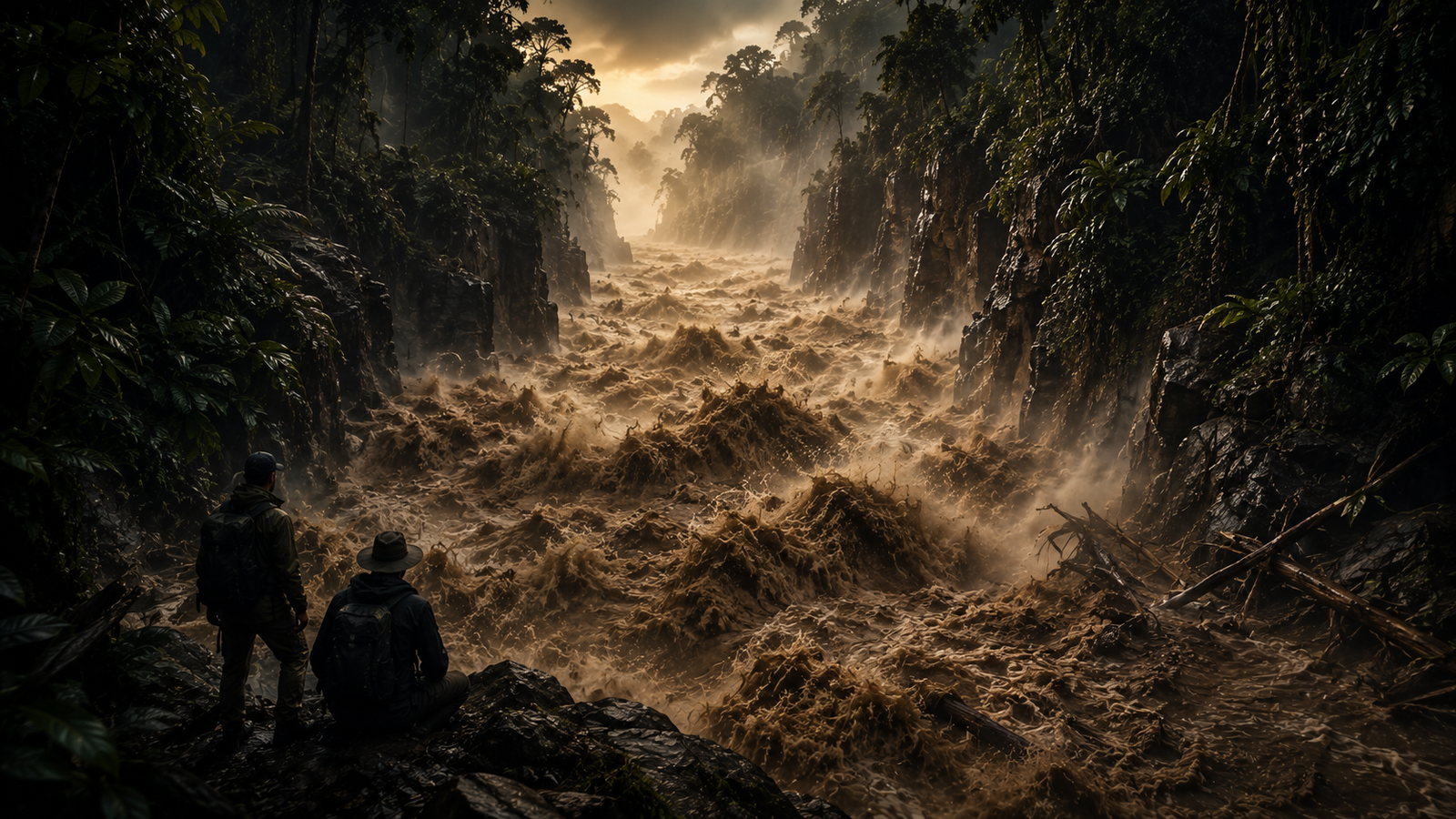
When the worst of it had passed, we climbed back down to what remained of the bank, soaked and shaking, to find that most of our spare supplies had been swept away with the current. Among the few things we managed to save was Theo’s damaged field journal, which had been tucked deep inside my bag rather than left in the canoe. Its final legible entry, written only days before he disappeared, stopped me completely.
“If I don’t return by the full moon,” it read, “do not follow the eastern channel. Whatever you do, take the long way around.”
I looked up from the page toward the fork in the river ahead of us, where the main channel we had been following was now completely blocked by a wall of fallen trees and debris from the flood. The only route still open, the only way to continue upriver at all, was the eastern channel.
The one Theo had begged us never to take.
Part Four: The Eastern Channel
We stood at that fork for almost half an hour, arguing in low, tired voices about what to do next. If we turned back now, it could take days to find another way around the blocked channel, and every day we lost was another day Theo might not have. If we pushed forward into the eastern channel despite his warning, we would be walking directly into whatever had frightened an experienced surveyor enough to write those words in his own journal.
I kept turning the page over in my hands, as if staring at it long enough might change what it said. Part of me wanted Iko to simply make the decision for both of us, and another part of me was afraid of exactly what kind of person that made me, willing to let someone else carry the weight of a choice this heavy. In the end, it was Iko who spoke first anyway. “Whatever scared him,” he said quietly, “he is still out there with it. If we do not go and find him now, no one else will.” I did not argue. Some part of me had already known we were going to take that channel from the moment we saw it was the only way through.
The eastern channel was narrower and stranger than anything we had traveled through so far, the water eerily still in places where it should have been moving, the banks lined with pale, cracked ground that did not look entirely solid. Iko warned me to stay exactly in his footsteps, and I understood why within the hour, when the ground beneath one of my own steps gave a low, hollow groan before I quickly pulled my foot back.
“It isn’t ground,” Iko said grimly, tapping the surface ahead of us with a long pole. “It’s a crust. There is empty space underneath, and water moving through it. If you break through in the wrong place, the current under there could pull you somewhere we would never be able to reach you.” He said it plainly, without drama, which somehow frightened me far more than if he had shouted the warning instead.
We moved for nearly two hours like that, testing every step before committing our full weight to it, the forest around us unnaturally silent, as if even the birds had learned to avoid this stretch of the river. I kept my eyes fixed on Iko’s boots, matching his path exactly, and tried not to imagine what waited beneath the pale ground if it ever gave way completely.
We found Theo less than an hour later, half sunk into exactly that kind of ground, one leg trapped beneath a collapsed section of the false earth, his supplies scattered uselessly around him. He was pale, exhausted, and clearly in pain, but very much alive, and the look on his face when he saw us was something I will never fully be able to describe in words.
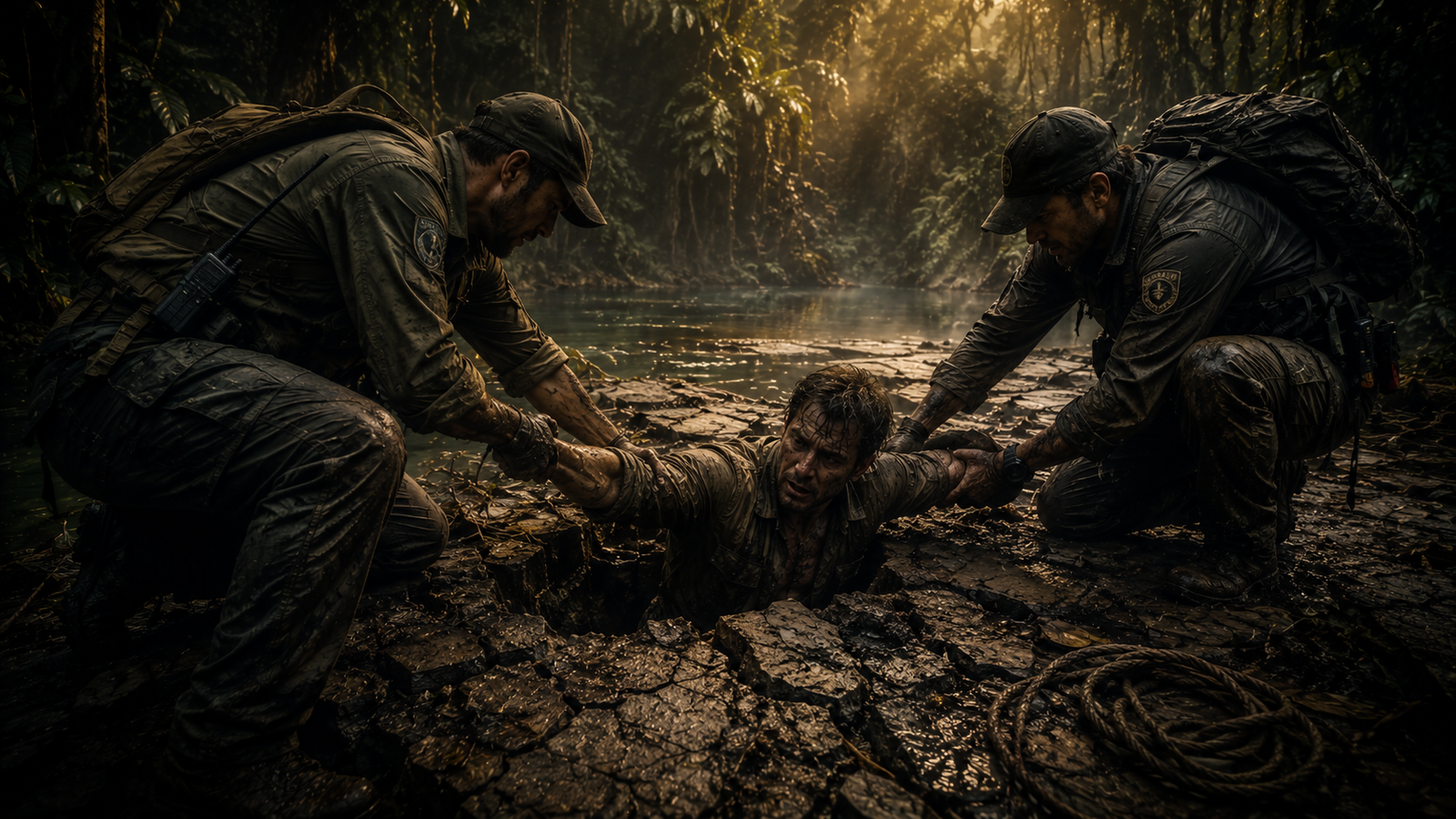
“If you had come one more day later,” he said, his voice cracked and hoarse, “I don’t think I would have made it.”
Freeing him took almost an hour of careful, painstaking work, testing every inch of ground before either of us moved, while Iko explained in a low voice exactly which sections might collapse further if we put too much weight on them. If we had rushed even once, we could easily have lost him again, this time for good, and I made myself move slower than instinct wanted, no matter how much I wanted to simply pull him free. By the time we finally worked his leg loose, my hands were shaking so badly I could barely tie the last bandage.
Part Five: What the River Gave Back
We made it back down to the main river two days later, exhausted, injured, and far quieter than we had been on the way up. Theo drifted in and out of sleep for most of the journey, his leg wrapped and splinted as well as we could manage with what we had left. I sat beside him for most of those two days, watching the water and thinking about how differently this trip could have ended.
If the flood had reached us thirty seconds earlier, if Iko had chosen the wrong footing on that false ground, if we had turned back at that fork instead of pushing forward, none of us would be sitting in this canoe right now. I used to think adventure meant chasing the exciting parts, the discoveries and the unmapped channels. Now I understood that it also meant carrying the weight of every decision that could have gone the other way, long after the danger itself had passed.
Theo never did tell us exactly what he had found out there, the discovery that had pulled him past the point where his own warning should have stopped him. Whenever I asked, he only said it could wait until he was strong enough to write it up properly, and something in his eyes told me it was still worth everything it had cost us to bring him home. I decided, for now, to let that be enough of an answer.
As the research station finally came into view downriver, I found myself already wondering, quietly, whether I would go back out there with him when he was ready to return. A year earlier, I would have said no without a second thought. Now, watching the last bend of the river slide past us in the fading afternoon light, I was not so certain anymore.
I did not have an answer yet. But for the first time since we had found that empty canoe, I realized I was not afraid of whatever the answer might turn out to be.
The End
Key Vocabulary
| Word | Meaning | Example |
|---|---|---|
| expedition | A long, organized journey made to explore a place or do research. | “The scientists planned a six-month expedition to the Arctic.” |
| tributary | A smaller river or stream that flows into a larger river. | “The village sits where a small tributary joins the main river.” |
| submerged | Completely covered by water, so it cannot be seen. | “The old bridge was fully submerged after the heavy rain.” |
| treacherous | Very dangerous, often in a hidden or unexpected way. | “The mountain path was treacherous after the ice storm.” |
| resolve (noun) | Strong determination to do something difficult. | “Her resolve to finish the race never weakened, even when it started raining.” |
| faltered | Became weaker or less steady for a moment, often from fear or tiredness. | “His voice faltered when he saw how high the cliff really was.” |
| downpour | A sudden, very heavy fall of rain. | “We ran for shelter as soon as the downpour started.” |
| ridge | A long, narrow area of higher ground. | “From the ridge, you could see the whole valley below.” |
Ready for another gripping read? Try The Door at 3:03 AM: A B1 Horror Story.