

In the village of Ashmere, the dark itself is not the danger. What it costs to keep the dark away, that is what truly frightens people. Selin has spent her whole life learning to read the flame of a lantern. Tonight, for the first time, the flame is asking her for something she never thought she would have to give.
Table of Contents
Part One: The Cost of Light
The village of Ashmere sits where the fields end and the Hollow Wood begins, and for as long as anyone can remember, the two have lived in an uneasy balance. Selin had grown up hearing the old warning from her mother: never walk past the last fence post after dark, because the Wood does not forgive curiosity. She had believed it was a story for children until the night she saw the Shadow Bloom herself, a slow grey mist that crept between the trees and left the grass beneath it white and lifeless, as though the color had simply been drained away.
The Lanternkeepers existed because of the Bloom. Each keeper carried a lantern that could push the mist back, but the light never came for free. To burn brighter than an ordinary flame, the lantern demanded a memory, drawn gently but permanently from the person who lit it. A small light asked for something small, a forgotten name or a half remembered song. A great light, one strong enough to hold the Bloom at the edge of a whole village, asked for something that mattered.
Selin was nineteen and had been apprenticed to Master Ilyas for three years. She had lit dozens of ordinary lanterns by now, and each time she felt the small tug of loss afterward, she told herself it was worth it. Tonight, however, felt different. Elder Tamsin had come to the Keepers’ hall just after sunset, her face pale in the lamplight.
“The Bloom has reached the eastern fields,” Tamsin said. “If it crosses the river tonight, it will reach the village center within three days. We need a vigil lantern, not an ordinary one. Something built to last until the spring rains come.”
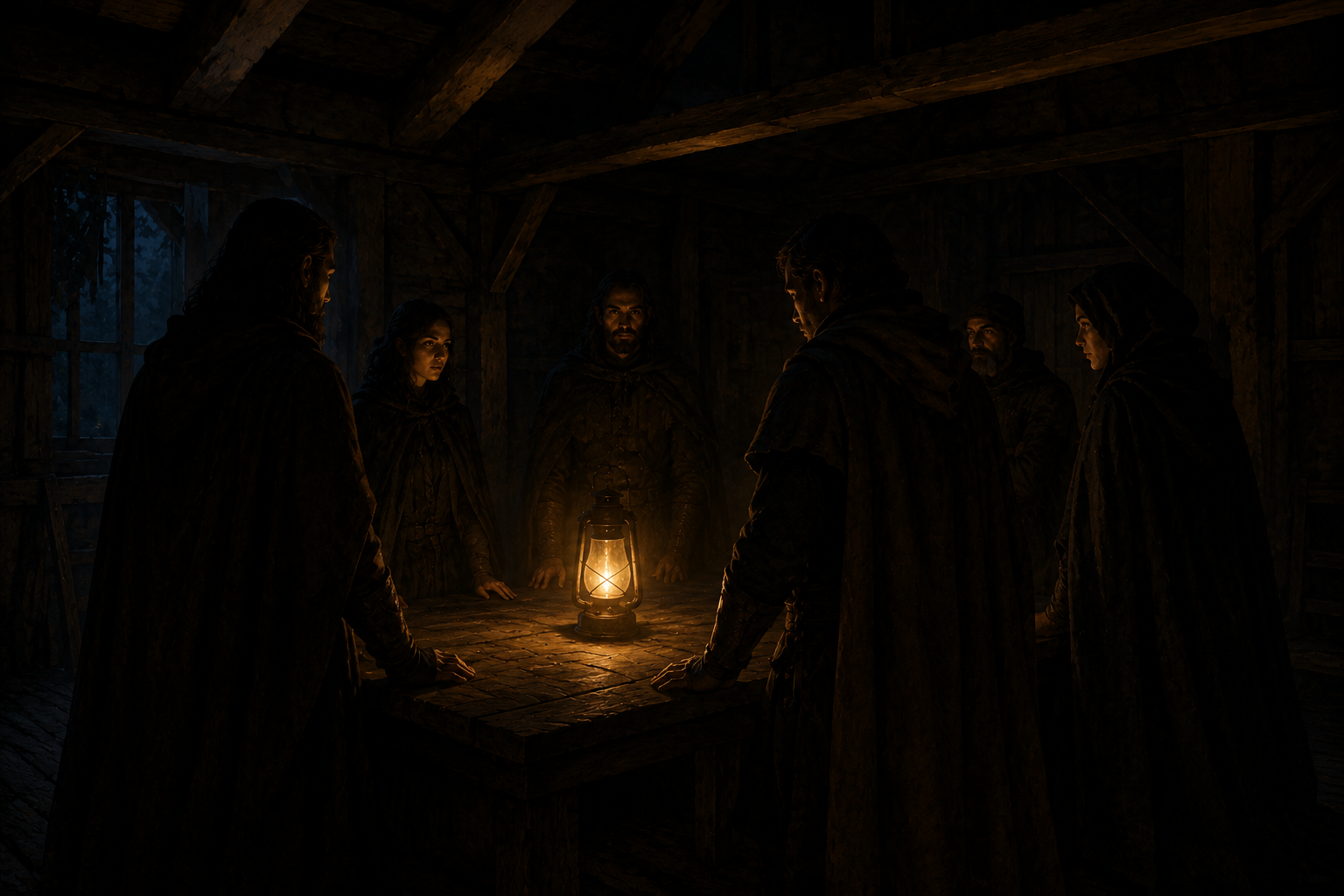
A vigil lantern required a keystone memory, one of real weight, and everyone in the hall understood what that meant. Nobody spoke. Master Ilyas looked older than Selin had ever seen him, his hands folded tightly on the table in front of him, as though he were holding something back.
Later that night, Selin walked home along the narrow path that ran beside the fields, thinking of her mother, Maren, who had been sick for months and grew weaker with each passing week. When Selin was six years old, her mother had taught her the same skill that now defined her life, and she could still see it more clearly than almost any other memory from her childhood.
She had been six years old, sitting cross legged on the cold kitchen floor while her mother knelt across from her with a single candle between them. The window had been open, and a thin draft kept pulling at the flame, bending it sideways before it straightened again.
“Watch it closely,” Maren had said. “A flame that is hiding something leans away from you, even when there is no wind to blame. A flame that is telling you the truth steadies itself, no matter what is happening around it.”
“How do you know that’s true?” young Selin had asked, suspicious in the particular way that only children are.
Her mother had laughed, low and warm, and the sound of it had filled the small kitchen completely. “Because my mother taught me, and her mother taught her, long before either of us ever became keepers ourselves. Some things are worth trusting simply because they have been true for longer than anyone can remember.”
Selin had not understood, that afternoon, that she was being taught the first and most basic skill of a lanternkeeper. She had only understood that her mother’s hand was warm where it rested near the candle, and that she wanted, more than anything, to learn to read light the way her mother did, easily and without fear.
It was, Selin realized as she walked home that night, the memory she loved most in the world. She had not told anyone yet, but she suspected it was also the memory she would have to give.
Rennick was waiting for her at the fence, as he often did. He had known Selin since they were children, back when his father still lived in the house at the end of their street. His father had been a keeper too, once, before he traded away so much of himself that he no longer recognized his own son in the way he used to.
“Don’t,” Rennick said, before she could speak. “I already know what Tamsin asked for, and I know what you’re thinking of giving. My father gave a keystone memory when I was eight. He never talks about my mother the way he used to. He forgot the sound of her laugh, Selin. He told me that himself, and I watched something in him go hollow after that.”
Rennick had not always spoken about his father so plainly. When they were children, he used to boast that his father’s lantern had once held back the Bloom for an entire month, and he had said it the way other boys bragged about a father who could lift the heaviest cart or outrun the fastest horse. It was only later, after the trade, that Rennick stopped boasting and started watching his father’s face instead, searching for pieces of the man who used to sing while he worked.
“He still loves me,” Rennick had told Selin once, years ago, sitting on this same fence. “I know that much hasn’t changed. But he loves me the way you might love a stranger’s child who reminds you of someone, gently and from a slight distance, as if he is not quite certain why the feeling is there.”
“The village needs the lantern,” Selin said quietly.
“The village always needs the lantern,” Rennick said. “That is exactly the problem. If nobody ever refuses, the Order will never have to ask what the trade truly costs. Have you ever wondered where the memories go once they are taken? Nobody has ever seen one returned.”
Selin did not have an answer for him. She only knew that if she said no, someone else would have to say yes, and she was not certain she could live with that either.
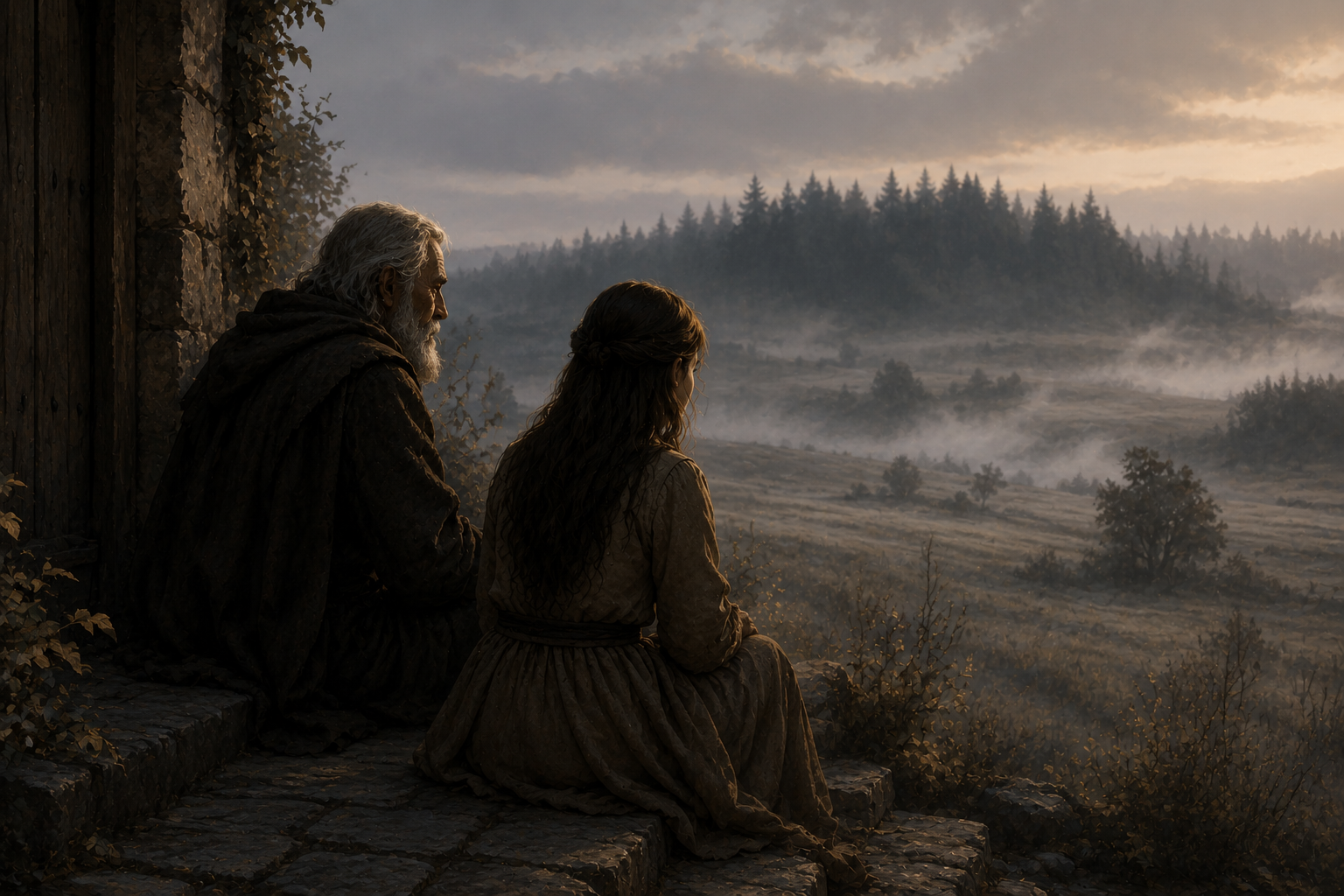
The next morning, Master Ilyas found her sitting outside the Keep, watching the grey line of mist far off across the fields. He sat beside her without being asked, which he rarely did.
“I traded a keystone memory once,” he said. “Twenty years ago, before you were born. I gave up the memory of the day I fell in love with my wife. I know that I loved her, because everyone who watched us together told me so for years afterward, and because some feeling of her still lives in me, whether I gave the memory away or not. But I could not tell you her voice on that particular morning, or what she said that made me certain. It is a strange kind of grief, Selin, to know that you have lost something you cannot even properly describe.”
“Why did you never tell me that before?” Selin asked.
“Because I wanted you to choose this path for yourself, not because an old man’s sadness convinced you it was noble,” Ilyas said. “If you decide to volunteer tonight, I need you to understand exactly what you will and will not get back.”
That afternoon, Selin sat at her mother’s bedside, and though she had not said what she planned to do, Maren seemed to sense it anyway.
“You have your father’s stubbornness,” Maren said, her voice thin but amused. “Whatever you are about to do, I trust that you have thought about it properly.”
“I have,” Selin said, though she was not entirely sure that was true.
“Then I will not ask you to explain it,” Maren said. “Just come and tell me about it afterward, in whatever way you still can.”
Selin held her mother’s hand for a long while before she left, and if she was memorizing the shape of her mother’s fingers, the weight of her rings, the warmth of her palm, she told herself it was only because she loved her, not because she suspected this might be one of the last ordinary evenings they would have exactly as they were.
Master Ilyas watched her go that night from the doorway of the Keep, and for a long moment he allowed himself to feel something he rarely permitted, a quiet, complicated pride tangled together with an old and familiar grief. He had chosen not to stop her, though he could have. He could have lit the vigil lantern himself again, could have offered some fragment of himself that he had little use for anymore, an old man’s memory instead of a young woman’s. He had not, and he was still turning over the reasons why.
Perhaps it was because he had watched too many keepers over the years try to protect the young ones from every cost, only to raise a generation that understood nothing of what they were truly guarding. Perhaps it was simply that Selin had asked to carry this weight herself, clearly and without illusion, and he respected her too much to take that choice away. Either way, he would not sleep easily tonight, and he suspected he had not slept easily on the night of his own vigil either, twenty years ago, though the memory of that particular sleeplessness, like so much else from that year, no longer belonged to him.
Part Two: The Trade
At the threshold, the vigil lantern stood taller than Selin, its brass frame etched with the names of every keeper who had lit one before her. Master Ilyas placed his hand on her shoulder, and the rest of the Order stood in a wide circle, their own smaller lanterns glowing faintly around the edges of the clearing like a ring of watchful eyes.
“You do not have to do this,” Ilyas said, quietly enough that only she could hear.
“I know,” Selin said. “But if I have to lose it eventually anyway, I would rather it save something.”
She had not told him what “eventually” meant, and she did not intend to. Her mother was dying, slowly and gently, and there would come a day, not far off now, when the memory of that candle on the kitchen floor would belong only to Selin, with no one left who remembered it happening. Perhaps that was not a good enough reason to give it away. Perhaps grief had simply found the nearest door and walked through it, disguised as courage. Selin did not have the distance to know for certain, and she suspected she never fully would.
She opened the small glass door of the vigil lantern and pressed her palm flat against the cool metal plate inside, the way Ilyas had shown her that afternoon. The flame inside did not flicker toward her the way ordinary lanterns did. It seemed to wait, patient and enormous, as though it already understood what it was about to be given.
“Think of the memory clearly,” Ilyas said. “Do not try to hold on to it. It will not hurt less for the holding, and it will only make the trade slower.”
Selin closed her eyes and let herself remember. The kitchen floor was cold beneath her small legs. The candle flame leaned to the left, toward the open window, and her mother’s hand steadied it without quite touching it. Watch how it leans when it is hiding something, her mother said, her voice younger than Selin had heard it in years. Watch how it steadies when it is telling the truth.
The lantern’s flame grew, slowly at first and then all at once, spilling gold light across the clearing and out toward the dark line of the Wood. Selin felt the memory loosen inside her chest, the way a stitch loosens when the thread finally gives, and then it was simply gone, not painfully, but completely, leaving behind only the strange, hollow certainty that something used to be there.

She did not fall, though for a moment she thought she might. Around her, the keepers were already pointing toward the tree line, where the grey mist had begun to thin and pull back, retreating the way smoke retreats from an open door. It would not vanish entirely, not until the spring rains came properly, but it would hold at the river for now, and that would be enough to keep Ashmere safe through the worst of the season.
Rennick found her afterward, sitting alone at the edge of the clearing while the others celebrated near the hall. He did not say I told you so, which she had half expected, and he did not offer false comfort either.
“What did you lose?” he asked instead.
“I’m not entirely sure,” Selin said, and it was true. She knew, in the way one knows the shape of a room in the dark, that something specific and precious was missing, but she could not say exactly what it had been, only that it had involved her mother and a kitchen and something about light. “I know it mattered. I just can’t tell you how anymore.”
Rennick sat beside her without speaking for a long time. Then he said, “My father always told me the same thing, that he knew something mattered but could no longer say why. I used to think that made the trade meaningless, that if you can’t remember why something was precious, it might as well never have happened at all.”
“And now?”
“Now I think I was wrong,” he said slowly. “Watching you tonight, I don’t think the meaning disappears. I think it just moves somewhere you can’t reach it anymore. That’s not nothing. It’s just harder to carry.”
When Selin returned home, her mother was awake, propped up against a pile of pillows, waiting for her the way she always did after a vigil.
“Tell me,” Maren said.
Selin opened her mouth to answer and found, to her own surprise, that she still had something to give her, even without the memory itself. She told her mother about the candle on the kitchen floor, not as something remembered, but as something Rennick and Ilyas and the whole village had watched her carry to the lantern that night, a story now held by other people instead of by her alone.
“It sounds like it was a good memory,” Maren said, smiling faintly.
“I think it was,” Selin said. “I wish I could tell you exactly how it felt. I only know that I would have given it to keep the village safe, and that I would probably do it again.”
Her mother reached for her hand, and Selin let her take it, grateful for the plain, uncomplicated fact of it, a warmth that needed no memory to explain itself.
In the weeks that followed, Selin returned to her duties at the Keep, though something in her had shifted. She began keeping careful records of what each vigil truly cost, memory by memory, name by name, something the Order had never bothered to document before, as if writing it down might make the trade feel less like a secret. Master Ilyas did not stop her. If anything, he seemed relieved that someone finally had.
The Bloom would return, everyone in Ashmere understood that much. It always did. But for the first time since she had become a keeper, Selin found that she was no longer afraid of what the next vigil might ask of her, only determined that whoever paid the price, herself included, would understand clearly what they were choosing to lose, and why it still mattered even after it was gone.
The End
Key Vocabulary
| Word | Meaning | Example |
|---|---|---|
| vigil | a long period of watching or staying awake for something important | The family kept a vigil at the hospital all night. |
| hollow | empty inside, or feeling empty emotionally | After the bad news, he felt hollow for days. |
| keystone | the most important part that everything else depends on | Honesty is the keystone of a good friendship. |
| grief | deep sadness, usually after losing someone or something important | She still feels grief when she thinks of her old house. |
| threshold | the entrance to a place, or the point where something begins | He paused at the threshold before going inside. |
| boast | to talk proudly about something you have done | He always boasts about his new job. |
| illusion | something that looks real or true, but is not | The painting created an illusion of deep space. |
| retreat | to move back and away from something | The cold weather made the tourists retreat indoors. |
| stubbornness | refusing to change your mind, even when others disagree | Her stubbornness helped her finish the race, even when it was hard. |
| disguised | hidden, or made to look like something else | The old barn was disguised by trees and bushes. |
| steady | calm and not shaking or changing suddenly | He took a deep breath to steady his hands. |
| precious | very valuable or important to someone | Her grandmother’s ring was precious to her. |
Ready for another story? Continue with The Blue Envelope: A B1 English Mystery Story.