
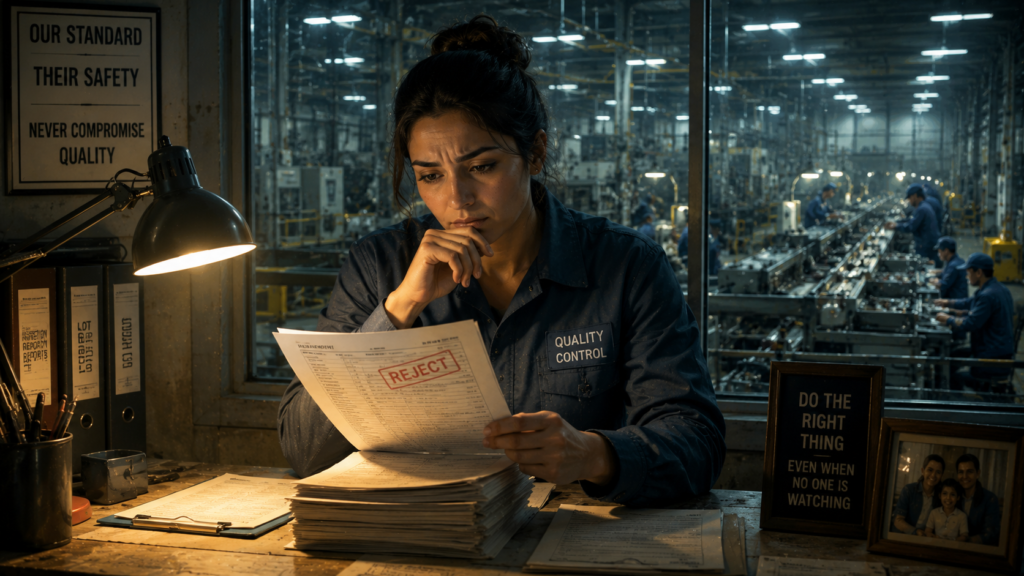
Aisha has known for four months that the safety inspection records at the plant are being quietly falsified to meet production deadlines. She has told herself, repeatedly, that it isn’t technically her responsibility to fix, that raising it would cost her a job she genuinely cannot afford to lose as a single mother of two. Then a corroded valve fails on the floor below her office, and a coworker she has known for six years ends up in the hospital.
Table of Contents
- Part 1: What Aisha Already Knew
- Part 2: The Justifications
- Part 3: The Accident
- Part 4: The Report
- Part 5: What It Cost
Part 1: What Aisha Already Knew
Aisha had worked as a quality control inspector at Harmon Manufacturing for six years, long enough to recognize the subtle signs of corners being cut before most people even noticed anything was wrong at all.
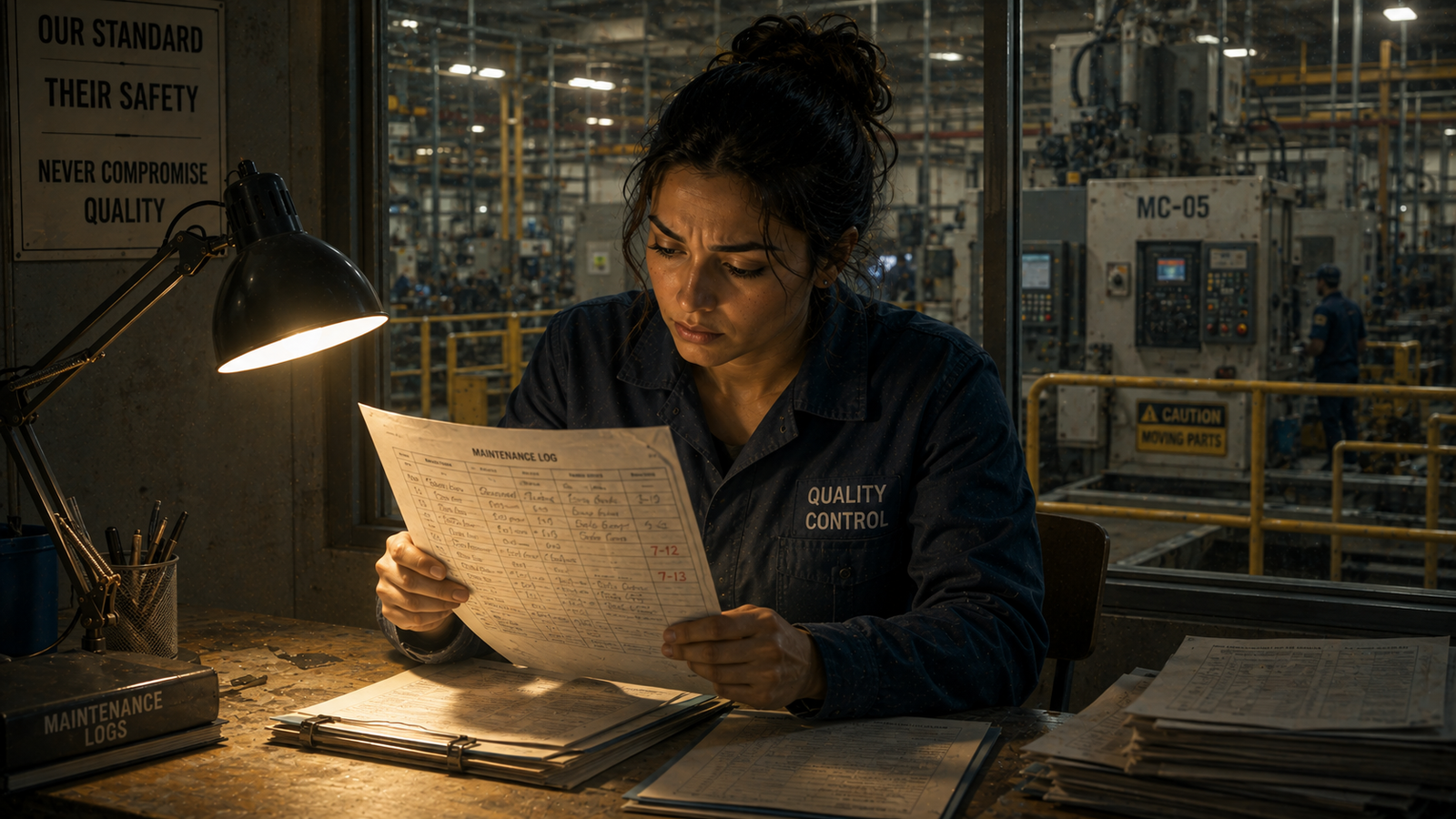
It had started small, four months earlier: an inspection date quietly adjusted on a maintenance log, a safety check marked complete that she was fairly certain hadn’t actually happened. She’d mentioned it once, carefully, to her direct supervisor, Mr. Whitfield, who had simply reassured her that production deadlines occasionally required flexible scheduling, and that the equipment itself remained perfectly safe regardless of exactly when paperwork got filed.
“You’re overthinking normal operational flexibility,” he’d told her, not unkindly, though the conversation had left Aisha with a persistent, uneasy feeling she’d struggled to fully shake since.
Over the following months, the pattern had grown considerably harder to ignore. Aisha found herself reviewing documentation more carefully, noticing discrepancies between claimed inspection dates and her own memory of the actual maintenance schedule, discrepancies that consistently favored keeping the production line running rather than genuinely confirming equipment safety.
She had told herself, repeatedly and with increasing difficulty, that raising formal concerns wasn’t strictly her responsibility, that the compliance department existed precisely to catch problems like this, that her own job as a single mother supporting two children simply couldn’t absorb the risk of becoming known as someone who caused trouble for management.
Part 2: The Justifications
“You’ve mentioned this three times now,” her sister, Reem, said during one of their weekly phone calls, concern evident in her voice. “What exactly are you waiting for?”
“I don’t have definitive proof of anything,” Aisha said, though even as she said it, she recognized the excuse for what it likely was. “Just some inconsistent paperwork. Maybe there’s an innocent explanation I’m simply not seeing.”
“Do you actually believe that?” Reem asked directly.
Aisha was quiet for a long moment. “I believe I can’t afford to lose this job right now,” she admitted finally. “Zayd starts middle school this year. Mona’s asthma medication alone costs more than I’d like to think about. I can’t risk becoming the person who gets quietly managed out of a company for raising uncomfortable questions.”
“That’s a real concern,” Reem said carefully. “I’m not dismissing it. I just want you to be honest with yourself about what’s actually driving the decision. It’s not really uncertainty about the facts, is it?”
Aisha didn’t have a good answer for that, and the question sat uncomfortably with her for the following weeks, resurfacing at inconvenient moments, during quiet drives home, during sleepless nights when the day’s easy justifications felt considerably less convincing than they had in daylight.
Part 3: The Accident
The accident happened on a Tuesday afternoon, roughly four months after Aisha had first noticed the falsified inspection dates.
A pressure valve on the production floor’s main processing line, one specifically listed as inspected and cleared just two weeks earlier, failed catastrophically during a routine shift change. Hot steam and debris sprayed across a section of the floor where Marcus, a maintenance technician Aisha had known personally for six years, happened to be working at exactly the wrong moment.
Marcus survived, though with serious burns requiring extended hospitalization and what doctors described as a genuinely difficult recovery ahead.
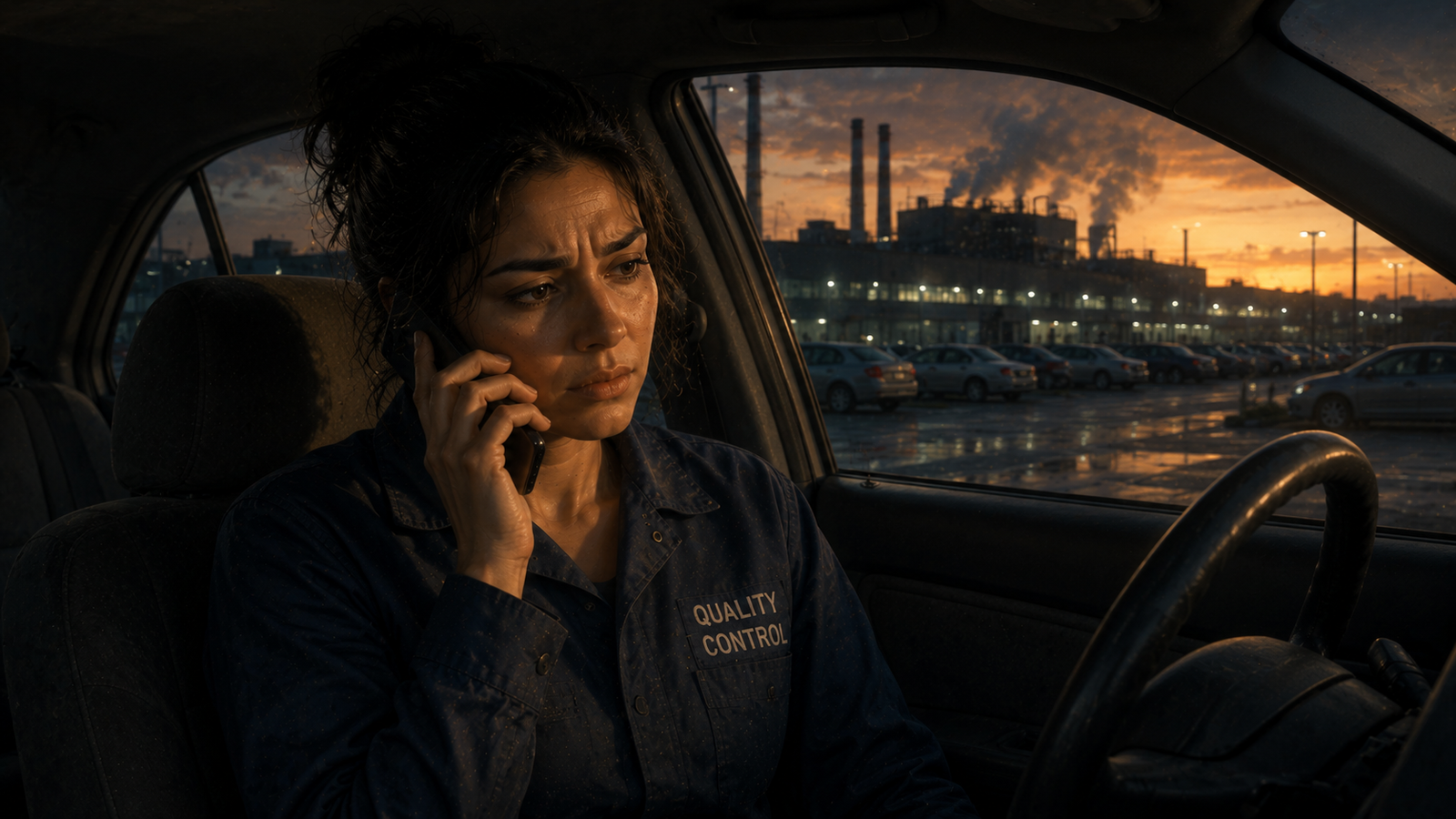
Aisha sat in her car in the parking lot that evening for nearly an hour, unable to fully process what had happened, replaying every month of careful, convenient justification she’d constructed for herself against the reality of Marcus now lying in a hospital bed because a valve that should have been properly inspected simply hadn’t been.
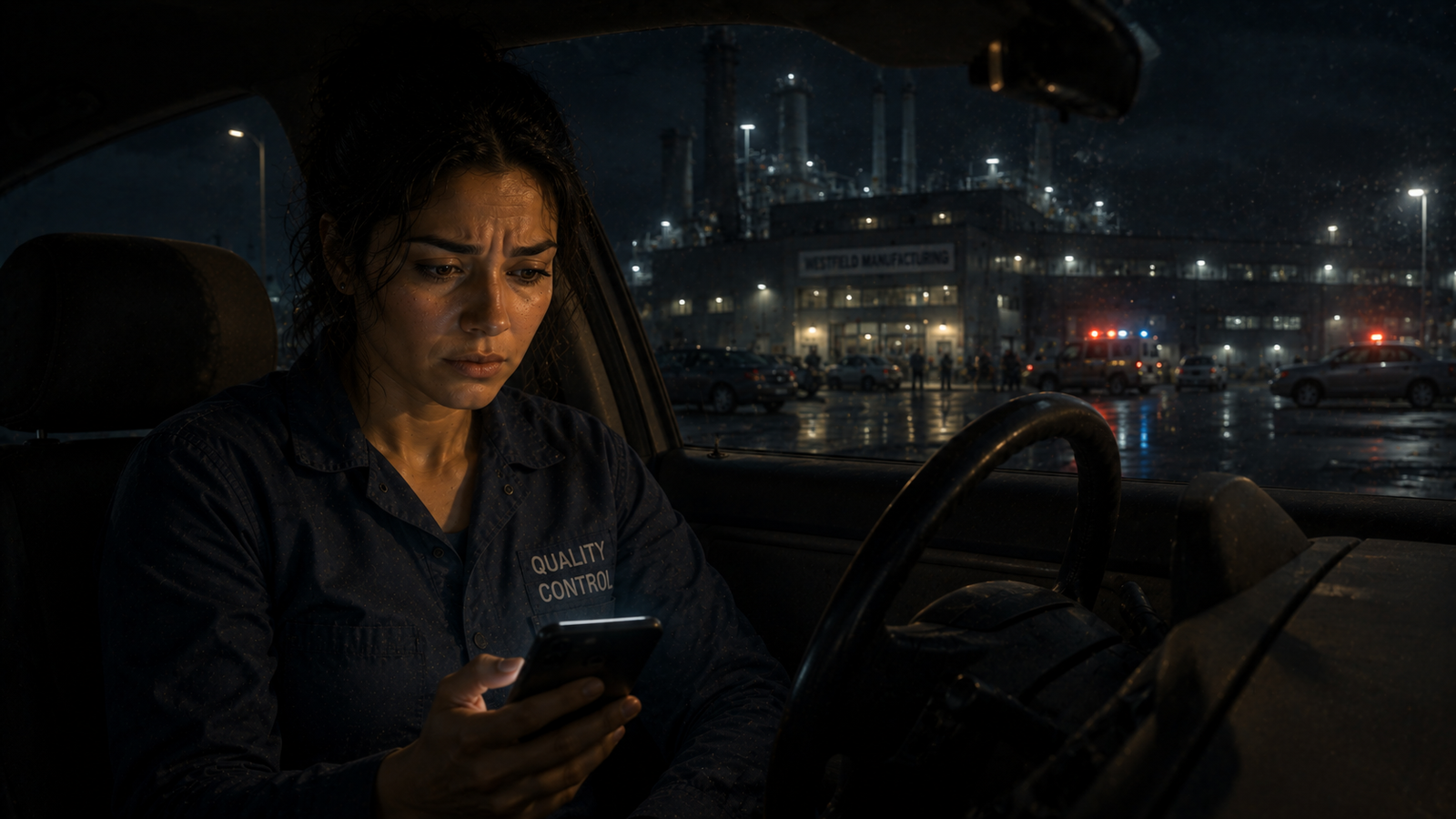
Her phone buzzed with a message from Mr. Whitfield, sent to several senior staff members simultaneously: a carefully worded reminder about maintaining discretion regarding “ongoing equipment matters” while the incident was formally reviewed internally.
Aisha read the message twice, something in her finally, completely shifting.
Part 4: The Report
She submitted a formal, detailed report to the regional safety board the following morning, before she could talk herself out of it again, documenting every inconsistency she’d carefully noted over the previous four months, every date discrepancy, every corner she’d watched quietly get cut in the name of production deadlines.
The investigation that followed moved faster and more thoroughly than Aisha had expected, regulators reviewing not just the failed valve, but the plant’s entire maintenance history over the preceding year.
The findings were serious: a pattern of falsified safety documentation extending well beyond what Aisha herself had even noticed, systemic pressure from upper management to prioritize production quotas over proper safety protocols across multiple departments.
Mr. Whitfield was terminated within the month. The plant faced significant regulatory fines and was required to implement extensive new safety oversight measures. Marcus, slowly recovering, was informed of the investigation’s findings and, through his union representative, expressed genuine gratitude toward whoever had finally brought the pattern to light.
Aisha’s name remained officially confidential throughout the investigation. It didn’t stay that way for long, not in a plant where people had worked alongside each other for years and eventually pieced together timelines on their own.

Part 5: What It Cost
The plant didn’t fire Aisha, whistleblower protections and the investigation’s serious findings made that legally difficult, but the atmosphere around her shifted noticeably in the weeks that followed.
Some coworkers, aware that the resulting safety overhaul had led to genuine improvements, treated her with quiet, careful respect. Others, including several colleagues facing reduced overtime hours as the plant adjusted its production schedules to accommodate stricter safety protocols, made their resentment considerably less subtle.
“Some people are calling you the reason half our department lost overtime pay,” a coworker told her bluntly one afternoon in the break room, not entirely unsympathetically.
“I know,” Aisha said. She’d genuinely wrestled with that exact tension herself, understanding completely why some colleagues felt aggrieved by financial consequences they hadn’t personally caused, even while knowing with complete certainty that Marcus’s recovery would have been considerably harder to justify weighing against anyone’s overtime pay.
“Do you regret it?” the coworker asked.
Aisha considered the question honestly, thinking of Marcus, still slowly recovering, of Mr. Whitfield’s carefully worded messages about discretion, of her own four months of convenient, comfortable justification.
“No,” she said finally. “I regret waiting four months before doing it. I don’t regret actually doing it.”
Reem, during their next weekly call, asked essentially the same question. “Was it worth it?” she asked. “Given everything it’s cost you at work?”
“I don’t know if ‘worth it’ is really the right question,” Aisha said slowly, still working through her own complicated feelings about the entire situation. “I think some things just genuinely need doing, regardless of what they end up costing the person who finally does them. I’m not particularly comfortable with how things turned out. I’m also not sure comfort was ever really the standard I should have been measuring this against.”
The End
| Word | Meaning | Example |
|---|---|---|
| Falsified | made false or fake, especially official records or documents | “The company falsified its financial records for years.” |
| Discrepancy | a difference between things that should actually match | “There was a discrepancy between the two reports.” |
| Discretion | careful judgment about what to say or do, often to avoid revealing something | “He handled the sensitive matter with discretion.” |
| Catastrophically | in a sudden, extremely damaging way | “The old bridge failed catastrophically during the storm.” |
| Systemic | affecting an entire system, not just one isolated part | “The report revealed systemic problems throughout the organization.” |
| Aggrieved | feeling resentful or unfairly treated | “Several employees felt aggrieved by the sudden schedule changes.” |
Quick Check
- What has Aisha noticed for four months before the accident happens?
- Why does Aisha initially decide not to report her concerns?
- What happens to Marcus, and how does it change Aisha’s thinking?
- What are some of the consequences Aisha faces after submitting her report, both positive and negative?
- Aisha says she isn’t sure “comfort” was ever the right standard for measuring her decision. What do you think she means by that? Do you agree with her final view of the situation?
Looking for another gripping read at a similar level? Continue with The River That Doesn’t Wait | B2 Adventure Story.