
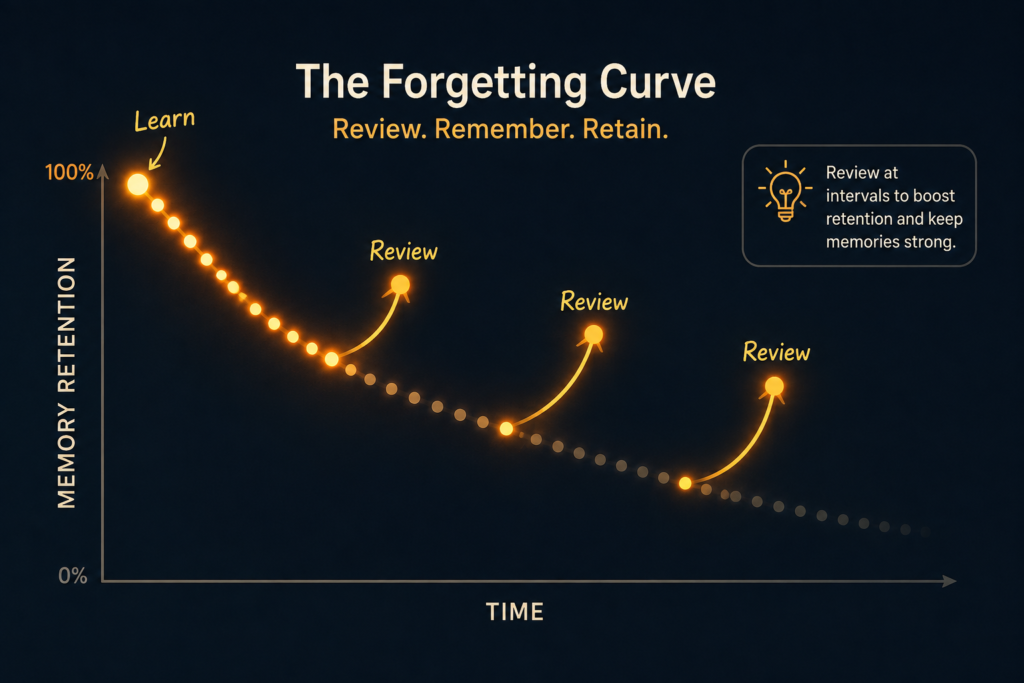
Picture Layla. Sunday night, she writes twenty new English words in her notebook, feeling proud of herself. Wednesday morning, she opens the same page and just stares. Twelve of those words feel like they belong to a stranger. If that sounds familiar, you are not bad at learning English. You just met the forgetting curve, and here is exactly how to beat it.
What You’ll Learn
- What the “forgetting curve” is, and why it explains your biggest learning frustration
- How much of what you learn today you will actually lose by tomorrow
- Why forgetting is not a personal flaw, but something every human brain does on purpose
- Why cramming a word list once is one of the least effective ways to remember it
- What a real English vocabulary classroom study found about spaced review
- A simple review schedule you can start using with any new English words today
Table of Contents
- What Is the Forgetting Curve?
- How Fast You Actually Forget New Words
- Why Your Brain Does This on Purpose
- The Fix: Why Spacing Beats Cramming
- Real Proof From an English Vocabulary Classroom
- How to Build Your Own Review Schedule
- Sources
What Is the Forgetting Curve?
In the 1880s, a German psychologist named Hermann Ebbinghaus sat alone in a room for months, memorizing long lists of made-up, meaningless syllables like “WUX” and “KEB.” He had no vocabulary app, no classmates, no shortcuts. Just lists, a clock, and his own memory as the experiment. He tested himself again and again after different amounts of time had passed, trying to find out exactly how memory behaves once new information goes in.
His results showed that memories weaken steadily over time, and that the biggest drop in retention happens soon after learning, not weeks later. This pattern became known as the forgetting curve, and it is still one of the most tested ideas in memory research today. But Ebbinghaus did not stop at bad news. He also found that reviewing information at the right moments slows that steep drop. Forgetting, it turns out, is not a fixed fate. It is a pattern you can interrupt, exactly the way Layla is about to learn.

How Fast You Actually Forget New Words
Here is the uncomfortable part, and the part that explains Layla’s Wednesday morning perfectly. Without any review, people tend to forget up to 50% of new information within just an hour, and that number can rise to about 70% within 24 hours. By the end of the week, most people retain only around 25% of what they originally learned. Left completely unreviewed, up to 90% of new information can be gone within a month.
Run the math on Layla’s twenty words. By Wednesday, the research predicts she should remember somewhere close to a third of them, not because she has a bad memory, but because that is simply what unreviewed information does inside every human brain. This is not a rare, personal failure. It is the default setting for everyone who has ever tried to learn a new language.
Why Your Brain Does This on Purpose
Here is the part that surprises most learners. Forgetting is not a bug in your brain. For a long time, scientists treated forgetting as a glitch, but researchers are increasingly realizing that the ability to forget is essential to how the brain actually works. Your brain is not failing to hold onto Layla’s twenty words. It is actively deciding, in the background, which information seems worth the long-term storage space and which does not.
That decision is not personal. It is based on repetition and use. Information you only touch once looks, to your brain, exactly like information you will probably never need again, so it gets deprioritized. This reframes the whole problem. You are not fighting a weak memory. You are simply not yet giving your brain a reason to treat these words as important. That reason has a name, and it is coming next.

The Fix: Why Spacing Beats Cramming
The good news is that psychologists have studied the solution in enormous detail. It is called the spacing effect, and it is one of the most consistently repeated findings in memory research. Studies going back decades have repeatedly shown that information is remembered better when repetitions are spread out over time, rather than repeated all at once in a single session.
This is not a small, shaky finding from one small study. One major review analyzed 839 separate tests of spaced versus massed practice, drawn from 317 experiments across 184 different research papers, and the pattern held again and again. Reviewing a word three times in one sitting feels productive. It barely slows the forgetting curve. Reviewing that same word once today, again in three days, and again next week is what actually signals to your brain that the word matters.
Real Proof From an English Vocabulary Classroom
This is not just a theory from a psychology lab with lists of nonsense syllables. It has been tested directly with English vocabulary, in a real classroom, with real students. In one study, researchers taught 39 fifth-grade children unfamiliar English words using two different methods, one with massed repetition and one with repetitions spaced about a week apart. Five weeks later, when the children were tested again, the group that reviewed the words with spacing between sessions remembered significantly more than the group that had repeated the words all at once.
That result matters because it describes the exact situation most English learners are actually in. Nobody is trying to memorize “WUX” and “KEB” for a lab experiment. Learners like Layla are trying to remember real, useful English words weeks and months from now, not just long enough to close the notebook feeling good on a Sunday night.
How to Build Your Own Review Schedule
You do not need an app, a subscription, or a complicated system to use any of this. A simple, well-tested pattern works: review a new word or phrase the same day you first meet it, then again the next day, then again after three or four days, then again after about a week, and once more after two to three weeks. Each review works best when it happens just as the word is starting to fade, which reinforces it right at the moment it needs it most.
In practice, this means you should never treat a new English word as “learned” just because you understood it once, the way Layla did on Sunday night. Keep a short, running list of words and phrases you meet in your reading or listening, and revisit that same list on a loose schedule instead of only ever moving forward to new material. Pairing this with material you naturally meet more than once, like a story you read and then hear again in a related podcast or exercise, gives you spaced repetition without it ever feeling like a chore or a flashcard drill.
If Layla had reviewed her Sunday list on Monday, then again on Thursday, then again the following week, Wednesday would have looked completely different. The words were never truly gone. They were only ever one well-timed review away from staying.
Sources
- Ebbinghaus’s Forgetting Curve, Mindtools
- What Is the Ebbinghaus Forgetting Curve? A Complete Guide, TalentCards
- The Forgotten Part of Memory, Nature
- The Influence of the Spacing Effect on L2 Vocabulary Learning, ScienceDirect
- Cepeda, N. J., Pashler, H., Vul, E., Wixted, J. T., & Rohrer, D. (2006). Distributed Practice in Verbal Recall Tasks: A Review and Quantitative Synthesis
- Sobel, H. S., Cepeda, N. J., & Kapler, I. V. (2011). Spacing Effects in Real-World Classroom Vocabulary Learning
- Repeat to Remember: Why Spaced Repetition Is the Key to Long-Term Learning, Achieve Tutoring