
You have studied English for years. You know the grammar rules. You can pass a test. But when a real person speaks to you, every word you learned disappears. The problem is not your memory, and it is not your age. The problem is the amount and the type of English going into your brain. There is a faster way. It is older than every textbook on your shelf. It is a story.

What You Will Learn in This Article
Most articles about learning English with stories tell you the same three things: stories are fun, read every day, do not use a dictionary. That advice is true, and it is not enough.
This guide gives you the full system. You will learn the exact number of words you need to know at each stage, and what each number unlocks. You will learn the 98 percent rule that decides whether a book will teach you or exhaust you, and a 60 second test to apply it. You will get the six step method, three advanced techniques that most learners never hear about, a 90 day plan in three phases, and a troubleshooting table that matches your exact problem to its real cause.
Everything here comes from published research in reading and vocabulary, written in simple English so you can start today.
Table of Contents
- Why Stories Beat Textbooks
- The Numbers Nobody Tells You
- Step 1: Find Your Right Level
- Step 2: Read a Lot, Not Hard
- Step 3: Read and Listen at the Same Time
- Step 4: Do Not Stop at Every New Word
- Step 5: Take a Second Pass for Language
- Step 6: Turn the Story Into Speaking and Writing
- Three Advanced Moves Most Learners Never Use
- Your 90 Day Plan
- Troubleshooting: Match Your Problem to Its Real Cause
- Five Mistakes That Slow You Down
- How to Know It Is Working
- The Simple Truth
- Sources
Why Stories Beat Textbooks
Most learners believe that studying harder means learning faster. So they buy a grammar book, they build long word lists, and they study for months. Then they meet a native speaker and freeze.
Here is why that happens.
Your brain is built for stories
Your brain does not like random information. It likes connected information.
In a well known memory experiment from 1969, one group of people memorized lists of unrelated words the normal way. Another group linked the same words into small invented stories. When both groups were tested later, the story group recalled around 90 percent of the words. The list group recalled around 13 percent.
Same words. Same time. Almost seven times the result.
A story gives every word a home. You do not remember the word escape because you wrote it in a notebook. You remember it because a woman ran down a dark hallway and found the door locked.
Stories repeat words for you, quietly
Vocabulary researchers agree that you need to meet a word many times before it becomes yours. Estimates vary, but most studies point to somewhere between 8 and 12 meetings for a word to stick, and often more for full knowledge.
Now compare two situations.
A word list gives you the word one time, maybe two. Then it moves on.
A 6,000 word story cannot do that. The main character has a job, a fear, and a problem, so the same natural words return again and again, in different sentences, in different moods, at different moments of tension. You meet refuse when she refuses the money, again when she remembers refusing, again when someone accuses her of refusing.
The story does the repetition work for you, and it does it without ever feeling like repetition. This is exactly why stories to improve English work so well. They deliver volume, repetition, and meaning in one package.
Meaning comes first, rules come later
The linguist Stephen Krashen spent decades defending one idea: we acquire language when we understand messages, not when we study forms. He called it comprehensible input, meaning language slightly above your current level but still understandable.
Children do not learn their first language from grammar tables. They learn it from thousands of hours of understandable, emotional, repeated language. Stories give adults the same experience in a smaller, faster, more organized package.
What stories give you that no app can
Vocabulary apps are useful for review. They cannot give you these four things, and these four things are what fluency is actually made of.
- Collocation. Which words live together. You learn that people make a decision and take a risk, not the opposite. No list teaches this. Stories teach it a hundred times without a single explanation.
- Register. When a sentence is polite, cold, angry, or friendly. You learn it from who says it and what happens next.
- Grammar in context. You meet the past perfect thirty times inside real events before anyone names it. When your teacher finally explains it, you are not learning it. You are recognizing it.
- Endurance. The ability to stay inside English for twenty minutes without your brain switching back to your language. This is a physical skill, like running distance, and only long texts build it.

The Numbers Nobody Tells You
This is the section most articles skip, and it is the section that will save you months.
How many words do you actually need?
Not all words are equal. A small number of words does most of the work in English. Here is what vocabulary research tells us about what each stage unlocks.
| Word families you know | Roughly how much of a normal text you understand | What this feels like |
|---|---|---|
| 1,000 | about 75 to 80 percent | You catch the topic, you lose the details |
| 2,000 | about 85 to 90 percent | Everyday conversation opens up |
| 4,000 to 5,000 | about 95 percent | Comfortable reading with support, real progress |
| 6,000 to 7,000 | about 98 percent of spoken English | You follow films and podcasts without strain |
| 8,000 to 9,000 | about 98 percent of written novels | You read native books for pleasure |
Two things become obvious when you look at this table.
First, the gap between 2,000 and 8,000 is where most learners get stuck for years. This is the famous intermediate plateau, and it is not a mystery. It is arithmetic. You need roughly six thousand more words, and word lists cannot deliver six thousand words. Only volume of reading and listening can.
Second, 95 percent coverage is not “almost enough”. It sounds close to 98, but the difference is enormous in practice, which brings us to the most important rule in this whole article.
The 98 percent rule
Research on reading comprehension found that to read comfortably and pick up new words naturally, you need to already know about 98 percent of the words on the page. At 95 percent you can still follow with effort and support. Below that, reading turns into decoding, and decoding kills both learning and motivation.
Ninety eight percent sounds impossibly high. In practice it is simple:
One unknown word in every 50 words. That is about one or two unknown words per page.
Read that again, because it contradicts everything your instinct tells you. If a page has ten new words, that page is not challenging you. It is drowning you. You will finish it, understand little, remember nothing, and feel stupid, and none of that was your fault.
How much input actually equals progress
Here is the second uncomfortable number. Reading speed at each level looks roughly like this:
| Level | Comfortable reading speed |
|---|---|
| A1 | 70 to 90 words per minute |
| A2 | 90 to 110 |
| B1 | 110 to 140 |
| B2 | 140 to 180 |
| C1 | 180 to 220 |
| C2 | 200 to 250 |
Now do the math on your daily habit. Assume a modest 100 words per minute.
| Daily reading | Words per day | Words per year |
|---|---|---|
| 15 minutes | 1,500 | about 550,000 |
| 30 minutes | 3,000 | about 1,100,000 |
| 60 minutes | 6,000 | about 2,200,000 |
Compare that with a typical English class: 3 hours a week, and most of those hours are spent talking about English rather than living inside it. That is around 120 hours a year, and only a fraction of it is real input.
Thirty minutes a day of stories gives you more English contact in one year than three years of a normal course. That is the entire secret, and there is nothing clever about it.
The classic “book flood” studies support this directly. When schools replaced traditional lessons with large amounts of reading, students progressed noticeably faster in reading and general language ability than students in normal programs. The students were not more talented. They were simply swimming in the language instead of studying it from the shore.
So what does “fast” honestly mean?
It does not mean fluent in 30 days. Anyone promising that is selling something.
Fast means reaching in one year what most classroom learners reach in three. That is completely realistic, and the tables above are the reason why.

Step 1: Find Your Right Level
This single decision controls most of your result. Get it wrong and nothing else in this article can save you.
The 100 word test
Do this before starting any book. It takes one minute.
- Open the story to a random page in the middle, not the first page.
- Read exactly 100 words.
- Count the words you truly do not understand, not the ones you can guess.
0 to 2 unknown words: perfect. This is your learning zone. Read it. 3 to 5 unknown words: usable but slower. Good as a second book, not your main one. More than 5: too hard. Close it. This is not failure, it is information.
Test the middle of the book, never the opening page, because openings are often written more carefully and simply than the rest.
Match the level to the book, not to your pride
Graded readers are real stories written inside a controlled vocabulary, level by level. The plot is real, the emotions are real, but the language stays inside your reach. Roughly:
| CEFR level | Vocabulary size of the book | Typical story length |
|---|---|---|
| A1 | 250 to 400 headwords | very short, heavy illustration |
| A2 | 600 to 1,000 | short, one main problem |
| B1 | 1,200 to 1,600 | full plot, subplots begin |
| B2 | 2,000 to 2,800 | psychological depth, mixed tenses |
| C1 | 3,000 to 4,000 | literary, multiple storylines |
| C2 | unlimited | native level |
Many learners try a famous native novel and quit in chapter two. That is completely normal and it means nothing about your ability. Native novels usually require 8,000 to 9,000 word families for comfortable reading. Nobody arrives there by force. Everybody arrives there by volume.
A practical rule: if you reach for a dictionary more than twice on one page, that book is teaching you frustration, not English.
Choose the story, not just the level
Level decides whether you can read the book. Emotion decides whether you will.
Before committing, read the first two pages and ask one question: do I want to know what happens next? If the answer is no, change the book, even if the level is perfect. A correct level with no curiosity produces zero reading, and zero reading produces zero learning.
Step 2: Read a Lot, Not Hard
There are two ways to read in a second language, and confusing them costs learners years.
Intensive reading is studying a short difficult text closely. You analyze grammar, look up every word, translate. It has value in small doses.
Extensive reading is reading a large amount of easy material for meaning and pleasure. Reading specialists Richard Day and Julian Bamford built a full set of teaching principles around it, and two of them matter most here: the material must be easy, and the purpose is usually pleasure and general understanding.
Most learners do only intensive reading, then wonder why they are slow.
The 90 to 10 ratio
Your time should be about 90 percent easy reading and 10 percent study.
Easy reading builds speed, confidence, listening comfort, endurance, and the natural feeling of what “sounds right”. Study builds precision. You need precision, but precision without volume is a sharp knife with nothing to cut.
If that ratio feels lazy to you, that feeling is exactly the habit that has been slowing you down.

Step 3: Read and Listen at the Same Time
If you take only one practical technique from this article, take this one.
Play the audio of the story and follow the text with your eyes at the same time. Researchers call this reading while listening. Studies comparing it against reading alone or listening alone have found it produces stronger vocabulary gains and better comprehension for most learners.
Why it works so well:
- It repairs pronunciation silently. Many learners store a wrong sound for a word they have only ever seen written, and that wrong sound then blocks them from recognizing the word when a real person says it. Reading while listening prevents this from ever forming.
- It trains your ear at natural speed. You stop being shocked by real rhythm, because you can see the words your ear is still learning to catch.
- It kills translation. The audio pulls you forward, so there is no time to stop and translate each sentence in your head. This is the single biggest cause of slow reading.
- It uses two channels at once. The same meaning arrives through your eyes and your ears, which makes the memory stronger.
The four pass listening cycle
Do not listen to a story once and move on. Use the same story four times, in this order. It costs almost no extra time and multiplies the value.
- Pass one, read while listening. Normal speed. Follow with your eyes. Understand the story.
- Pass two, audio only, same day or next day. Now you know the plot, so your brain is free to notice sound instead of meaning.
- Pass three, audio only, while walking or cooking, three days later. Divided attention. This trains real world listening, where you never have full concentration.
- Pass four, read out loud yourself, one short section only. Copy the rhythm and the pauses of the narrator. Two minutes is enough. This is where listening turns into speaking.

Step 4: Do Not Stop at Every New Word
This is the hardest habit to break and the most important, because every stop breaks the flow, and the flow is where the learning lives.
Use this filter instead of your instinct.
Keep reading if:
- You can still follow what is happening.
- The word appeared only once.
- It is a small physical detail, like a type of flower, a fabric, or a piece of furniture.
Stop and check if:
- The sentence stops making sense without it.
- The word has now appeared three or more times.
- It clearly carries the emotion or the turning point of the scene.
How to record a word so it actually survives
When you do stop, do not write a translation and move on. A word alone is a fact. A word inside a sentence is a memory.
Record it in four columns:
| Word | The sentence from the story | Simple meaning in English | My own new sentence |
|---|---|---|---|
| refuse | “She refused the money without looking at it.” | to say no to something offered | I refused his help because I wanted to try alone. |
The fourth column is the one everyone skips and the one that does the work. Writing your own sentence forces the word out of recognition and into production, and those are two very different kinds of knowing.
Receptive and productive knowledge
Researchers separate the words you understand when you meet them from the words you can produce when you need them. Almost every learner has a large first group and a small second group, and that gap is exactly why you understand films but cannot speak.
Reading grows the first group fast. Only your own sentences, spoken or written, move a word into the second group. Choose ten words per story for this treatment. Ten owned words are worth more than fifty recognized ones.
Step 5: Take a Second Pass for Language
Here is a truth that honest researchers admit. One reading is often not enough. In one well known study, learners did pick up new words from a single graded reader, but a large part of that knowledge had faded three months later.
The answer is not to read harder. It is to come back.
Two days after finishing a story, go through it again quickly, and this time look at the language instead of the plot. Fifteen minutes is enough.
- Reread only the parts you marked.
- Read your marked sentences out loud, twice.
- Look at the small words around your new word. Do people make a decision or do a decision? Are they afraid of or afraid from? Do you take a photo or make a photo? These natural partnerships are called collocations, and they carry more real fluency than a hundred grammar rules.
Collect chunks, not just words
Instead of writing decision, write make a difficult decision. Instead of risk, write take a huge risk. Instead of mind, write change her mind at the last minute.
Chunks are how fluent speakers actually talk. Nobody builds sentences word by word in real time. They assemble ready made pieces. Every chunk you collect is a piece you no longer have to build under pressure.
Space your reviews
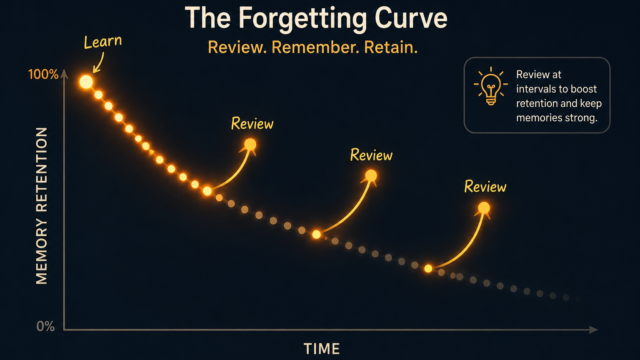
Memory fades on a curve. It drops fastest in the first days, then slows down. So review at growing distances rather than every day:
Day 1, day 3, day 7, day 21, day 60.
Five minutes each time is plenty. Use a notebook or a flashcard app, but only with sentences from stories you actually read. Never review a word you met in a list, because it has no memory to attach to.
Step 6: Turn the Story Into Speaking and Writing
Input builds understanding. Output builds control. You need both, and stories make output easy because you already have something to say. The blank page problem disappears when a story has just handed you characters, events, and a decision worth arguing about.
Choose one of these per story. Not all four.
- The 60 second retell. Close the book, record yourself telling the story out loud for one minute with no preparation. Listen back once, then delete it. Nobody else will ever hear it, so there is nothing to be nervous about.
- The character letter. Write 100 words as a letter from one character to another. This forces natural pronouns, tenses, and emotion.
- The different ending. Write five sentences describing another ending. This pushes you into conditionals and past tenses without a single grammar exercise.
- The one opinion. Write one honest opinion about a character’s choice plus one reason. This is exactly the skill tested in every speaking exam, and exactly the skill needed in every real conversation.
Keep it short. Four sentences you actually write beat four pages you plan to write.
Three Advanced Moves Most Learners Never Use
These three techniques separate learners who progress steadily from learners who stall at B1 forever.
1. Narrow reading
Instead of reading five books by five different authors on five different topics, read five books that are connected. Same author, same series, same character, or same subject.
The reason is pure efficiency. Every writer and every topic has its own set of frequent words. When you stay inside one world, the second book repeats most of the vocabulary of the first, so your comprehension jumps and your speed increases. Book one feels hard. Book three in the same series feels easy, and you did not become smarter in two weeks. You simply stopped resetting your vocabulary every time.
Krashen has argued for this approach for years under the name narrow reading and narrow listening. It is possibly the highest value habit in this entire article, and almost nobody does it, because variety feels more productive than it is.
2. Repeated reading for speed
Fluency is not only about knowing more. It is about using what you already know faster.
Take one page you already understand completely. Read it out loud, timed. Note the time. Read it again twice more. Time it once more. Your speed will rise noticeably, and that gain transfers to new texts.
This is the strand of learning that almost every self taught learner ignores. You are not learning anything new during those three minutes. You are making existing knowledge automatic, and automatic is what “fluent” actually means.
3. Balance the four strands
Paul Nation, one of the most respected researchers in vocabulary teaching, describes a balanced course as four equal strands, roughly 25 percent of your time each:
- Meaning focused input. Reading and listening you mostly understand. (Your stories.)
- Meaning focused output. Speaking and writing about real content. (Step 6.)
- Language focused learning. Deliberate study of words, chunks, grammar. (Step 5.)
- Fluency development. Doing easy things faster. (Repeated reading, rereading old books.)
Now be honest with yourself. Most learners spend 90 percent of their time on strand three and almost none on strands two and four. That imbalance, not lack of talent, is why progress stops.
If you keep only one idea from this article besides the 98 percent rule, keep this: your weakest strand is holding everything else back.
Your 90 Day Plan
Thirty minutes a day. Three phases. No app subscriptions required.

Phase 1, Days 1 to 30: Build the habit
The goal of this month is not vocabulary. It is attendance.
- Choose stories at your level using the 100 word test.
- 20 minutes daily reading while listening.
- Mark unknown words with a pencil, look up nothing during reading.
- After each story, do the 60 second retell.
- Finish 3 to 4 stories.
Do not change level this month, even if it feels easy. Easy is the point.
Phase 2, Days 31 to 60: Add depth
- Continue 20 minutes of reading while listening.
- Add the 10 minute second pass on the previous story, with your four column notes.
- Start the four pass listening cycle.
- Choose narrow reading: same author or same series for the whole month.
- Write one 100 word piece per story.
Phase 3, Days 61 to 90: Add speed and output
- Continue everything above.
- Add 3 minutes of repeated reading out loud, three times a week.
- Speak your retells for 90 seconds instead of 60.
- On day 85, run the 100 word test on a book one level higher.
Moving up: if you get 3 or fewer unknown words in 100, move up. If not, stay one more month. Staying is not lost time. It is the base that makes the next level fast instead of painful.
At this pace you finish around 12 stories in 90 days, and roughly 48 in a year. That is a serious amount of English living inside your head, built from half an hour of quiet time a day.
Troubleshooting: Match Your Problem to Its Real Cause
Most learners treat the symptom. Find your row and treat the cause instead.
| What you feel | The real cause | What to do |
|---|---|---|
| I read but remember nothing | The book is above 98 percent coverage, so all your effort goes to decoding | Drop one level immediately, no exceptions |
| I understand reading but not speech | You are reading silently, and your stored sounds do not match real speech | Reading while listening on everything, four pass cycle |
| I know the words but cannot speak | Your knowledge is receptive only | The fourth column, the 60 second retell, daily |
| I have been intermediate for years | You are stuck in the 2,000 to 8,000 word gap, which needs volume, not lessons | Raise input to 30 minutes daily, add narrow reading |
| My reading is painfully slow | You are translating in your head | Audio at natural speed forces you forward, plus repeated reading |
| I forget words a month later | No spaced review after the first meeting | Day 1, 3, 7, 21, 60 review schedule |
| I get bored and stop | Correct level, wrong story | Change the book, not the method. Curiosity is not optional |
| Grammar still confuses me | You are learning rules before you have met the patterns | Meet the pattern 50 times in stories first, then read the rule. It will feel obvious |
Five Mistakes That Slow You Down
1. Choosing a book that is too hard. Pride is expensive here. An easy book you finish teaches more than a hard book you abandon.
2. Translating every sentence in your head. Translation keeps English as a guest in your mind. Audio at natural speed is the cure, because there is no time to translate.
3. Studying word lists instead of stories. Lists give you words with no home, no emotion, and no repetition. They fade, and you blame your memory.
4. Changing method every two weeks. Every new app, every new channel, every new secret costs you the time you needed to simply read. Choose one path and walk it for 90 days before judging it.
5. Waiting until you feel ready to speak. You will never feel ready. Speak badly for one minute a day starting tonight. The stories give you the words. You only have to open your mouth.
How to Know It Is Working
Progress in a language is quiet, and that is exactly why so many people quit two weeks before it shows. Watch for these signs instead of watching the calendar.
Weeks 1 to 3: reading feels less tiring. You finish a session without your head hurting. This is endurance, and it is real progress even though it is invisible.
Weeks 4 to 8: you meet a word from a story out in the world, in a video or a song, and you understand it instantly with a small shock of recognition. Your reading speed on the same level rises.
Weeks 8 to 12: you read a full page and forget it was in English. Short English phrases appear in your head without you deciding to think them.
After week 12: a sentence sounds wrong to you and you cannot explain why. This is the most important sign of all. It means the language has moved out of your notes and into your instinct, and instinct is the thing no course can teach you directly.
None of this happens on day three. Almost all of it happens if you simply do not stop.
The Simple Truth
Learning English fast is not about talent, money, or living abroad. It comes down to two things: how much understandable English passes through your mind, and whether you enjoy it enough to keep going.
Grammar books give you rules you forget. Word lists give you words with no life. Stories give you both, wrapped inside something your brain was built to hold on to.
So tonight, pick one story at your true level, not the level you wish you had. Press play, follow the words with your eyes, and do not stop for anything.
Do that for 90 days, and nobody will need to tell you it is working.
You will feel it.
Sources
Everything in this article comes from published research on reading and vocabulary. You can read the original work here.
- Bower, G. H., and Clark, M. C. (1969). Narrative Stories as Mediators for Serial Learning. Psychonomic Science. https://doi.org/10.3758/BF03331297
- Krashen, S. D. (1982). Principles and Practice in Second Language Acquisition. Full book, free from the author. http://www.sdkrashen.com/content/books/principles_and_practice.pdf
- Krashen, S. D. Articles on reading, narrow reading, and comprehensible input. http://www.sdkrashen.com/
- Day, R. R., and Bamford, J. (2002). Top Ten Principles for Teaching Extensive Reading. Reading in a Foreign Language, 14(2). https://nflrc.hawaii.edu/rfl/October2002/day/day.html
- Hu, M., and Nation, P. (2000). Unknown Vocabulary Density and Reading Comprehension. Reading in a Foreign Language, 13(1). https://nflrc.hawaii.edu/rfl/PastIssues/rfl131nation.pdf
- Nation, P. (2006). How Large a Vocabulary Is Needed for Reading and Listening? Canadian Modern Language Review, 63(1). https://doi.org/10.3138/cmlr.63.1.59
- Nation, P. (2007). The Four Strands. Innovation in Language Learning and Teaching, 1(1). https://doi.org/10.2167/illt039.0
- Webb, S. (2007). The Effects of Repetition on Vocabulary Knowledge. Applied Linguistics, 28(1). https://doi.org/10.1093/applin/aml048
- Waring, R., and Takaki, M. (2003). At What Rate Do Learners Learn and Retain New Vocabulary from Reading a Graded Reader? Reading in a Foreign Language, 15(2). https://nflrc.hawaii.edu/rfl/October2003/waring/waring.html
- Brown, R., Waring, R., and Donkaewbua, S. (2008). Incidental Vocabulary Acquisition from Reading, Reading While Listening, and Listening to Stories. Reading in a Foreign Language, 20(2). https://nflrc.hawaii.edu/rfl/October2008/brown/brown.html
- Elley, W. B., and Mangubhai, F. (1983). The Impact of Reading on Second Language Learning. Reading Research Quarterly, 19(1). https://doi.org/10.2307/747337
- Paul Nation’s free vocabulary research, word lists and tools, Victoria University of Wellington. https://www.wgtn.ac.nz/lals/resources/paul-nations-resources