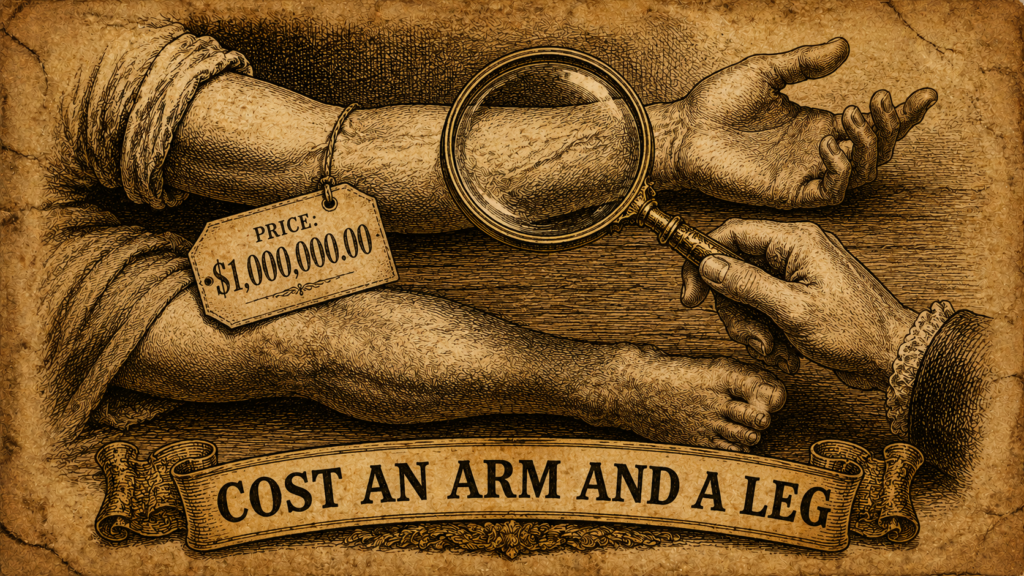
The case landed on my desk on a quiet afternoon, the kind of request that looks easy right up until you actually open the folder. Someone wanted to know where the phrase “cost an arm and a leg” really came from. Simple enough, I thought. Every idiom has a birth certificate hiding somewhere, buried in an old newspaper or a forgotten book of sayings. I have cracked tougher cases than this one before breakfast.
I was wrong. Three suspects, dozens of old newspaper pages, one royal coin patent from 1680, and a very long afternoon spent squinting at 18th-century painters’ invoices later, here is what I can tell you for certain: not one of the popular explanations fully checks out. This is the file of a case that never quite closed. And honestly, that might be the most interesting part of the whole investigation.
Quick Answer
“Cost an arm and a leg” means something is extremely expensive. The popular story blames old portrait painters who supposedly charged extra for painting limbs, but that story has no historical evidence behind it. After examining every documented theory, word historians still cannot agree on the idiom’s true origin, making this one of the rare cases genuinely marked unsolved.
What You’ll Learn
- What “cost an arm and a leg” means and how people use it today
- The popular painter myth almost everyone believes, and why it falls apart under investigation
- Two other competing theories, including a strange coin-based rumor from 17th-century Ireland
- Why serious word historians still cannot agree on where this idiom truly began
- How to use the idiom naturally in your own English
Table of Contents
- The Meaning
- Suspect One: The Painter
- Following the Paper Trail
- Two More Suspects
- The Confirmed Truth (Or Lack of One)
- How to Use This Idiom Today
- The Bigger Lesson About Unsolved Cases
- Sources
The Meaning
Before I introduce you to any suspects, let’s make sure we agree on what we’re actually investigating. When something “costs an arm and a leg,” it means the price is so high it almost hurts to think about. Not just expensive. Painfully, dramatically expensive. People say it about plane tickets, weddings, a single coffee in the wrong part of a big city, or, in my line of work, a decent cup of coffee anywhere at all.
It’s a phrase built entirely on exaggeration. Nobody actually loses a limb over a plane ticket. But that’s exactly what makes idioms like this one worth investigating in the first place: somebody, somewhere, decided that the price of something outrageous deserved a phrase this violent, this specific. Two body parts, not one. Why an arm and a leg, and not, say, an ear and a nose? That question turned out to be the first thread I pulled on, and it unraveled a lot further than I expected.
Suspect One: The Painter
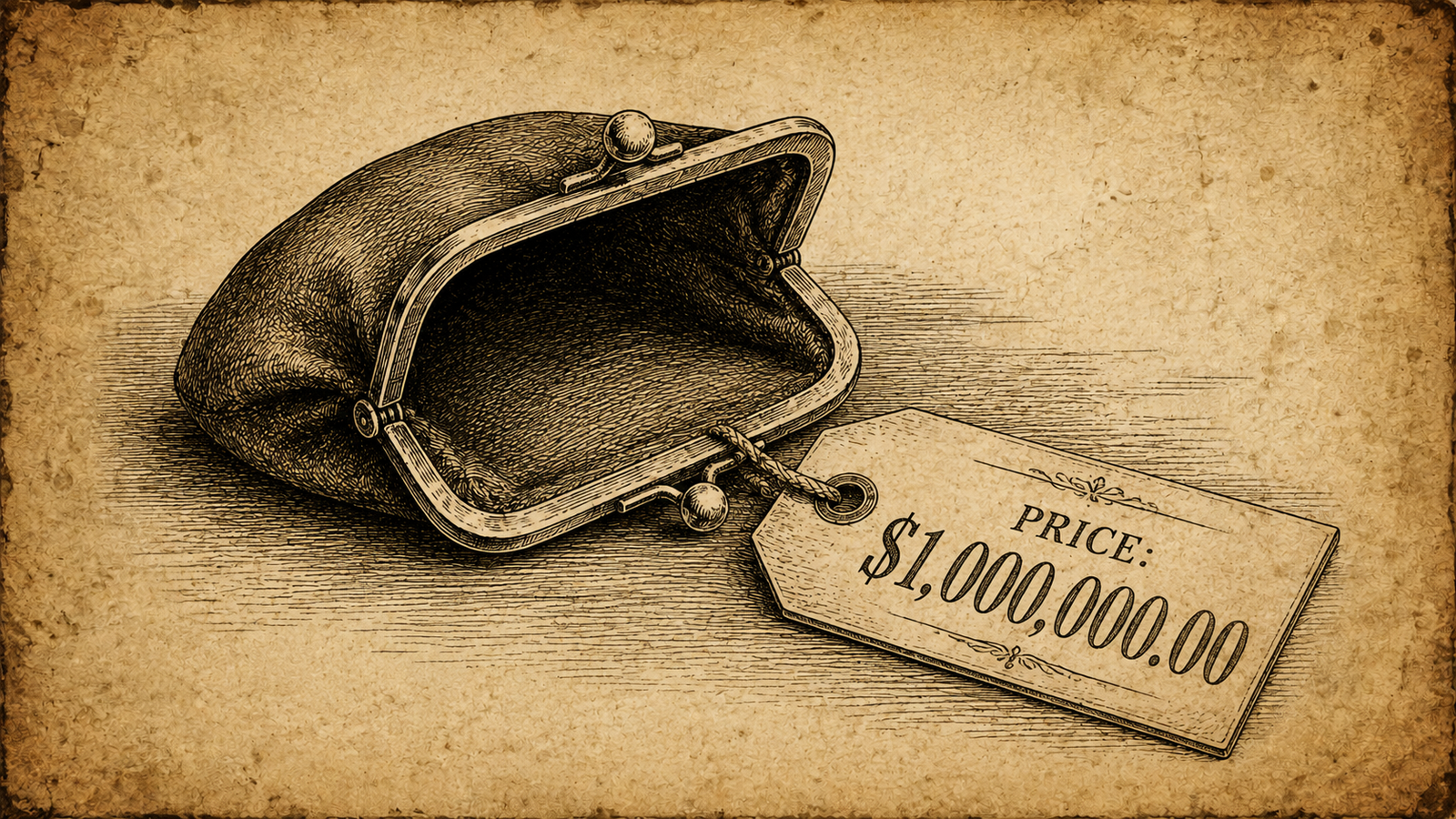
Ask nearly anyone where this idiom comes from, and you’ll hear the same story, told with total confidence, usually within about ten seconds. Back before photography existed, portrait painters supposedly charged their clients by the body part. A simple head-and-shoulders portrait was the cheap option. Want your arms included in the painting? That’ll cost you extra. Want the full picture, arms and legs and all? Well, that would genuinely cost you an arm and a leg.
I’ll admit it: the first time I heard this story, I almost closed the case right there. It’s tidy. It’s clever. It explains the exact body parts in the idiom instead of leaving them as a mystery. It even sounds like the kind of practical, slightly absurd pricing system an actual 18th-century painter’s studio might have used. A good detective, though, doesn’t fall for the suspect just because he’s charming and his story sounds rehearsed. So I went looking for the receipts. Literally.
Following the Paper Trail
Here’s where things got interesting. If painters really priced portraits by the limb, there would be evidence somewhere: a price list, an invoice, a painter’s personal ledger complaining about clients who wanted their legs included for free. Word historians who have actually gone digging through surviving 18th and 19th century painting records have found exactly none of that. What they have found is that painters priced their work based on the size of the canvas and how complicated the composition was, full stop. No itemized arms. No itemized legs. The painter’s alibi checks out. He’s innocent.
The paper trail gets even more damning once you check when this phrase actually shows up in print. If the idiom came from portrait painting, you’d expect to find it circulating heavily during the height of that art form’s popularity. Instead, one of the earliest known uses of anything close to this phrase appears in 1576, in an English translation of a French text, and it has nothing to do with money at all. It describes a difficult, tiring action costing someone “an arme or a legge,” purely in a physical, exhausting sense. The financial meaning we actually use today doesn’t clearly show up in print until the 20th century, long after portrait painters had largely been replaced by cameras. Suspect One had an alibi the whole time. He wasn’t even in the country when the crime, financially speaking, was committed.

Two More Suspects
With the painter cleared, I had two more names in the file, and neither one gave up easily.
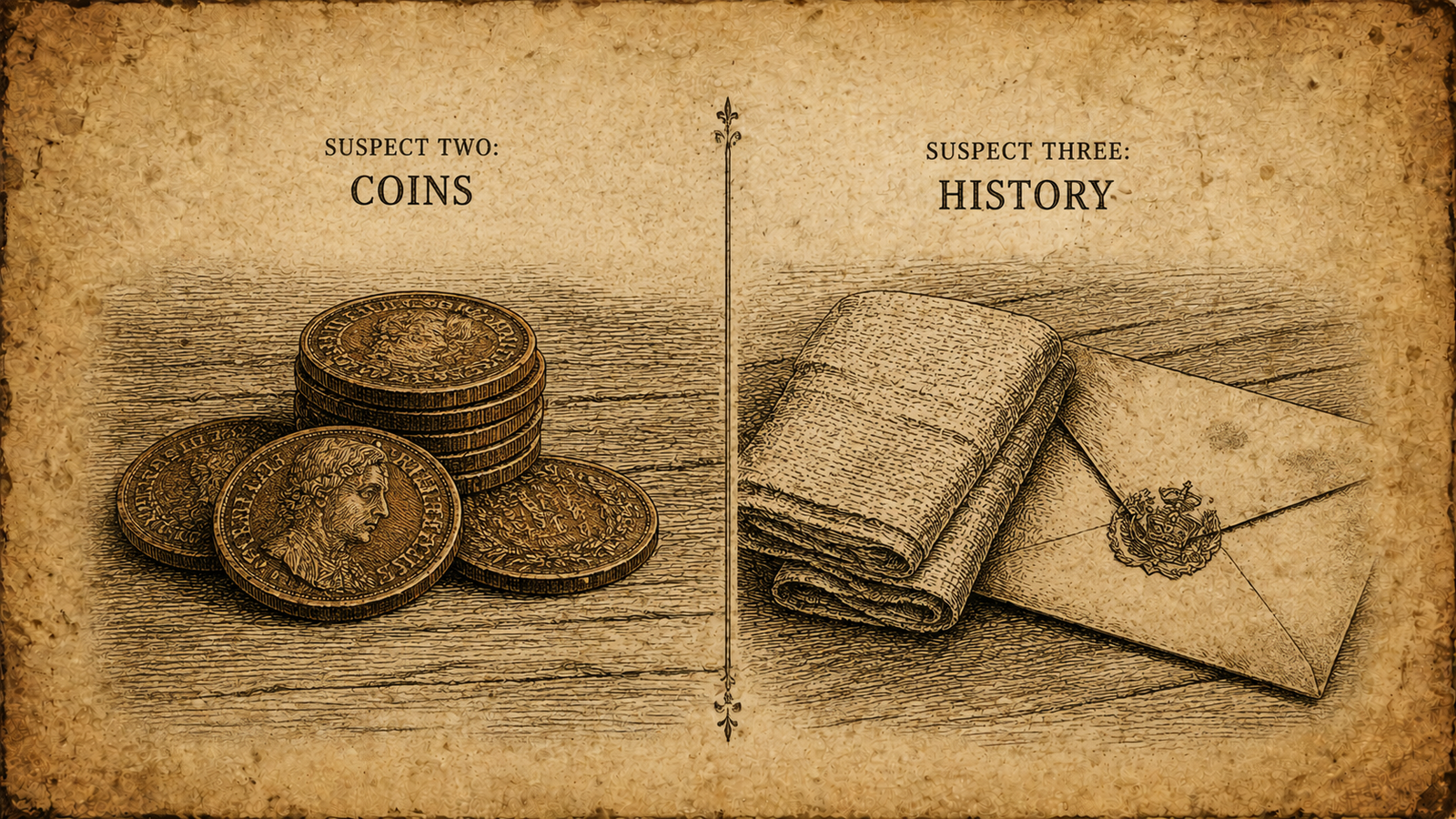
Suspect Two takes us to Ireland in 1680. King Charles II authorized two real, historical men, Sir Thomas Armstrong and Colonel George Legge, to manufacture copper halfpenny coins for use in the Irish colonies. According to the story, people started jokingly saying that some cheap little purchase “cost an Arm and a Legge,” a pun on the coin makers’ own names. It’s a fantastic piece of trivia. The men were real. The coins were real. What’s missing is any actual evidence that anyone in 1680 was walking around making that joke. No diary entry. No letter. No printed pun. The connection between the coin and the idiom appears to have been invented much later by someone who simply liked how neatly the names fit. A great story, built on a name that happened to match. Case not proven.
Suspect Three is the most serious of the three, and the hardest to fully dismiss. Newspaper archives show the phrase appearing around 1901, describing real accidents and real war injuries, quite literally. Some historians believe the financial meaning we use today may have grown out of the genuine cost paid by wounded soldiers, especially after World War II, when battlefield medicine improved enough that far more soldiers survived losing a limb instead of dying from the wound. Imagine the phrase evolving from a soldier’s literal, devastating price, paid in blood, into a lighter, everyday complaint about an overpriced couch. It’s a compelling theory, and unlike the other two suspects, this one isn’t built on thin air. But even this lead runs out of hard evidence eventually. No single wartime document, letter, or article draws a clean, provable line connecting soldiers’ injuries directly to the modern shopping complaint. A strong motive, in other words, but no fingerprints at the scene.
The Confirmed Truth (Or Lack of One)
This is the part of the file where most detectives are tempted to just pick their favorite suspect and stamp the folder closed anyway. I’m not going to do that to you.
Here’s what respected phrase historians actually agree on: the idiom is almost certainly American, and it most likely took its current financial meaning sometime in the mid-20th century, with clear examples showing up in print around 1949. That much is solid ground. But exactly which story, if any, sparked it in the first place remains genuinely unknown. It may not even trace back to one dramatic origin story at all. It could simply be a natural blend of older expressions, like “I’d give my right arm for that,” mixed with the general sense that a leg is worth quite a lot too, without any single tidy event behind it.
I know that’s an unsatisfying answer. I wanted a clean confession as much as you did. But a detective’s job is to follow the evidence, not to manufacture a happy ending where the evidence doesn’t support one.
How to Use This Idiom Today
Whatever its murky past, the idiom works perfectly well in everyday English, mystery and all.
- “We loved the apartment, but it cost an arm and a leg, so we kept looking.”
- “Concert tickets these days cost an arm and a leg.”
- “I don’t want to pay an arm and a leg for a suitcase I’ll only use twice a year.”
The Bigger Lesson About Unsolved Cases
Not every mystery gets a tidy ending, and that’s true for language just as much as it is for real investigations. Somewhere along the way, we got comfortable expecting a neat, confident answer for everything, especially online, where a charming story with no sources will always spread faster than an honest “we don’t fully know.” But pretending certainty where none exists does a disservice to real history, and honestly, to real curiosity too.
So the next time you hear a suspiciously perfect explanation for where a phrase comes from, do what I eventually learned to do with this one. Don’t just believe it because it’s clever. Ask a much quieter, more useful question: did anyone actually find the evidence, or did the story just sound too good to double-check?
This case stays open. I’m at peace with that now. Some files just don’t come with a bow on top.
Sources
Quick Check
- What does “cost an arm and a leg” mean?
- Why does the article compare the popular painter story to a suspect with a solid alibi?
- What is the Irish halfpenny coin theory, and why is it also considered doubtful?
- Why do word historians mark this idiom’s true origin as unknown instead of choosing one theory?
- Why do you think people enjoy sharing a “wrong” origin story even after it’s been debunked? What does that tell us about how legends spread?
Related Phrases
Curious about other famous idiom origins? Check out the true story of straight from the horse’s mouth for another investigation into a popular saying.